

You’re crashing out. Your chest is tight, and you can’t catch your breath. You text your friend. They responds: “Have you tried meditating?”
Your therapist suggests it. Your mom forwards you an article about it. Your manager mentions it in a wellness meeting. Even your Instagram ads are personally attacking you with it. “Just download Headspace.” “Calm changed my life.” “You literally just... breathe.”
And you’re sitting there like: I’ve been breathing my whole life and I’m still anxious? How is this the solution?
But fine. You download the app. You lie on your floor. You close your eyes. Breathe in. Breathe out. Breathe in. Breathe out. And now... you’re just anxious AND bored.
So why is something as basic as breathing—literally the thing keeping us alive—now a multi-billion dollar app industry? Does it actually work? And why does everyone act like it’s the cure to our generational burnout when half of us can’t afford to get past the paywall?
Meditation isn’t new. Practices like dhyana in India and breath-focused yoga were used for self-realization and liberation thousands of years ago. In China, Daoist and Confucian texts described “sitting in thoughtfulness” and breathing practices to harmonize internal energy (qi) with nature. Buddhism turned mindful breathing, known as anapanasati, into a central method for cultivating awareness and reducing suffering. This was all spiritual, community-based, and very much not monetized.
Then in the 1960s and 70s, meditation took off in the West as the counterculture movement embraced Eastern philosophy. You had figures like Steve Jobs going on a seven-month trip to India, coming back with his skin “turned a deep, chocolate brown-red from the sun” and becoming obsessed with Zen meditation, practicing it daily. He later said that the intuition he developed in India had a big impact on his work. The funniest part is that he literally helped birth the smartphone era while preaching the importance of disconnecting (to be fair he didn’t invent social media). The irony is not lost on us.
Fast forward to the 2010s and a new revelation was born: what if we could sell people back their own breath? Enter the meditation app industrial complex. Headspace launched in 2010, Calm in 2012. Suddenly, meditation wasn’t about sitting in a temple or joining a community. It was about “bite-sized guided sessions” and progress tracking. Meditation got a rebrand that was convenient, modern, and just happens to be subscription-based.
If you didn’t know, these meditation apps are thriving off Gen Z. According to survey data, one in five American Gen Zers have already tried a meditation app, and another quarter intend to. We’re the most active users of apps like Calm and Headspace, and it’s not hard to see why. Our generation treats mental health differently than older generations, as we see it as equally important as physical health. Gen Z is 20-50% more likely to engage with mental health apps than older generations, and 64% of us track at least one health metric like sleep, mood, or steps every single day. The number one reason for downloading these meditation apps? Reducing stress and anxiety (shocking, I know).
This has turned into a gold mine. The global meditation app market is growing at 10.5% annually through 2034. Headspace is valued at around $3 billion and Calm is worth roughly $2 billion. But despite downloading these apps en masse, many of us don’t actually use them. Why? The paywall. The lack of personalization. The fact that a subscription costs as much as four matcha runs and delivers way less dopamine. We’ll download the app and try the free trial, but good luck converting us into paying customers.
That is sad because meditation does work. The research is pretty conclusive. Studies show that nearly two-thirds of people who practiced meditation for six to nine months reduced their anxiety by 60%. Regular meditation can reduce emotional reactivity from your amygdala, increase gray matter in brain regions involved in self-awareness, memory, and introspection, and boost self-control and willpower. Research shows that just 10 to 21 minutes of meditation app exercises done three times a week is enough to see measurable results.
On paper, it’s great. But in practice? It’s complicated.
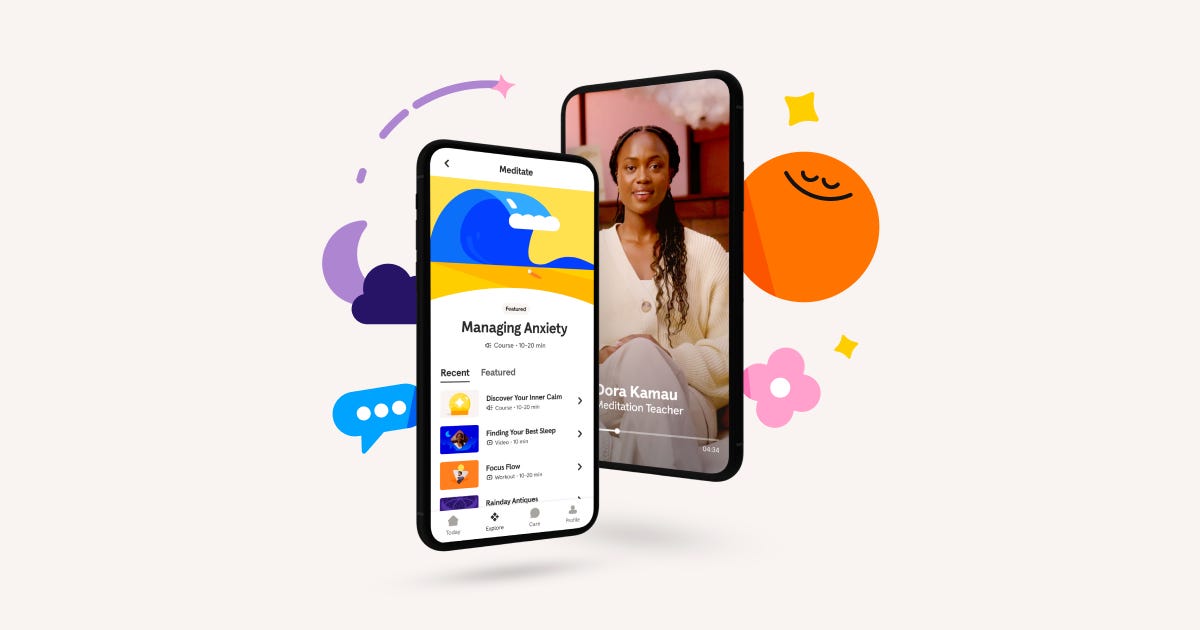
Speaking from personal experience, meditation can be a hit or miss depending on how you do it. When I’m anxious, sitting still and listening to some stranger’s soothing voice tell me to “notice my thoughts without judgment” doesn’t help because I literally cannot focus. But for me, hot yoga works wonders because the heat and the physical movement combined with the meditative practice actually calms my brain.
I’ve downloaded Headspace ten years ago and Calm five years ago. I don’t use either now. The digital experience is distracting because I end up doing something else completely (out of boredom). The content gets repetitive. And then there’s the $16.99 per month subscription. Absolutely not.
Turns out, I’m not alone. Gen Z has the highest churn rate with digital mindfulness apps. Why? Because 40% of us say too much tech harms our mental health and we’re the generation that invented “digital detox,” which are periods where we completely disconnect from technology. We’re willing to pay, but we’re savvy. We prefer freemium models and abandon apps with hidden costs or paywalls that pop up too early.
That said, I don’t discount meditation apps entirely. They can be great companions when you’re traveling, or when you need something quick and accessible. But here’s the thing: what doesn’t work for me might be exactly what works for you. Maybe you’ll find that Headspace voice soothing where I found it boring. Maybe a 10-minute guided breathing session before bed makes you feel at ease.
The point isn’t that meditation apps are bad or that in-person yoga is superior. The point is that meditation, in all its forms, has something to offer if you’re willing to explore it. Try the apps. Try different teachers, different styles, different times of day. But also dig deeper into the philosophy behind it. Learn about the thousands of years of practice that came before the rebrand.
Steve Jobs said this after his transformative trip to India:
“You can’t connect the dots looking forward; you can only connect them looking backwards. So you have to trust that the dots will somehow connect in your future.”
Maybe trying meditation feels pointless right now. Maybe you can’t see how sitting still and breathing will connect to anything meaningful in your future. But you have to trust the process, even when you’re anxious and bored on your bed at 2 AM. Somewhere in all of this—the apps, the classes, the ancient philosophy, the modern convenience—there might be something that actually helps. But you won’t know until you try.
The matcha part is real...