

World News — How To Win At Foreign Policy

Economists
Effective foreign policy demands a careful blend of principled leadership, dependable alliances, and unwavering strategic clarity—qualities that are largely absent from Donald Trump’s unpredictable, deal-focused approach. Instead of fostering trust and working within established diplomatic frameworks, Trump sidelines experts, threatening tariffs and wielding executive whim to coerce foreign powers, often sparking unnecessary feuds with key countries like India, Brazil, and South Africa. While his gut-driven, transactional style has resulted in some localized breakthroughs, such as mediating peace between Azerbaijan and Armenia, it simultaneously alienates America’s allies, rewards adversaries, and makes the global order more volatile. Trump’s reliance on personal instinct and flattery incentivizes manipulation by other countries, raises the risk of corruption, and reduces overall American influence. Ultimately, this method endangers long-term international stability, leaving America uncertain, its friends wary, and its enemies increasingly emboldened.
Tech — Intel Rises On Talks of Trump’s Administration Holding a Stake in the Company

CNBC
Intel’s stock jumped 7% after reports emerged that the Trump administration is actively discussing taking a direct U.S. government stake in the chipmaker, a move intended to support Intel’s delayed Ohio factory expansion and boost domestic semiconductor manufacturing. The talks follow a White House meeting between President Trump and new CEO Lip-Bu Tan, who took the helm after Intel’s failure to catch up in artificial intelligence chips and heavy foundry investments left the company floundering. This proposed investment signals a continued shift toward aggressive state involvement in vital industries, echoing recent government deals in chips and rare-earth minerals. Despite recent gains, Intel’s stock remains well below its highs after a 60% plunge in 2024, the company’s worst year on record, and its return to prominence hinges on securing major foundry customers and realizing ambitious manufacturing plans now under close scrutiny.
Market — China’s Economy Taking a Nosedive

Bloomberg
China’s economy showed a sharp slowdown in July 2025, with factory production and retail sales growth hitting their lowest levels this year, reflecting the mounting impact of Donald Trump’s trade war. Industrial output rose just 5.7% year-on-year, the slowest pace since November, while retail sales increased by only 3.7%, both below economist expectations. Fixed-asset investment growth decelerated to 1.6%, weighed down by a deepening real estate slump, and urban unemployment rose to 5.2%, higher than anticipated. Despite these challenges, exports remained a bright spot, though new loan growth contracted for the first time in two decades, signaling a cautious outlook among businesses and consumers. Extreme weather disruptions and traditionally slower seasonal activity further compounded the economic softness. While Chinese authorities have signaled commitment to existing supportive policies, they may adjust stimulus measures depending on upcoming data. The overall picture suggests that China’s economic momentum is flagging amid external pressures and structural domestic challenges, raising concerns about the outlook for sustained growth in the coming months.
Culture — China Claims to Want Woman to Have Children and a Career

Economists
China officially promotes policies encouraging women to balance careers and childbearing, offering legal maternity leave of up to 158 days in major cities and subsidizing childcare for young children. However, the government's push for "mum jobs"—flexible, lower-paid positions aimed at mothers with children under 12—has drawn criticism for marginalizing women into menial, hourly work rather than true career opportunities. These roles, prevalent in sectors like e-commerce and manufacturing, reinforce gender inequality and undercut working mothers’ prospects. Meanwhile, many women like Ms. Wang, who strive to maintain career momentum post-maternity leave, face workplace discrimination and penalties for taking legally entitled breaks, highlighting a disconnect between official pronouncements and real workplace culture. Despite rising female education and workforce participation, the combination of social expectations, limited job choices, and employer biases continues to hinder women’s full economic integration in China’s aging society. The debate grows over whether China’s solutions for working mothers genuinely empower them or simply mask deeper structural inequalities.
The Daily Spark
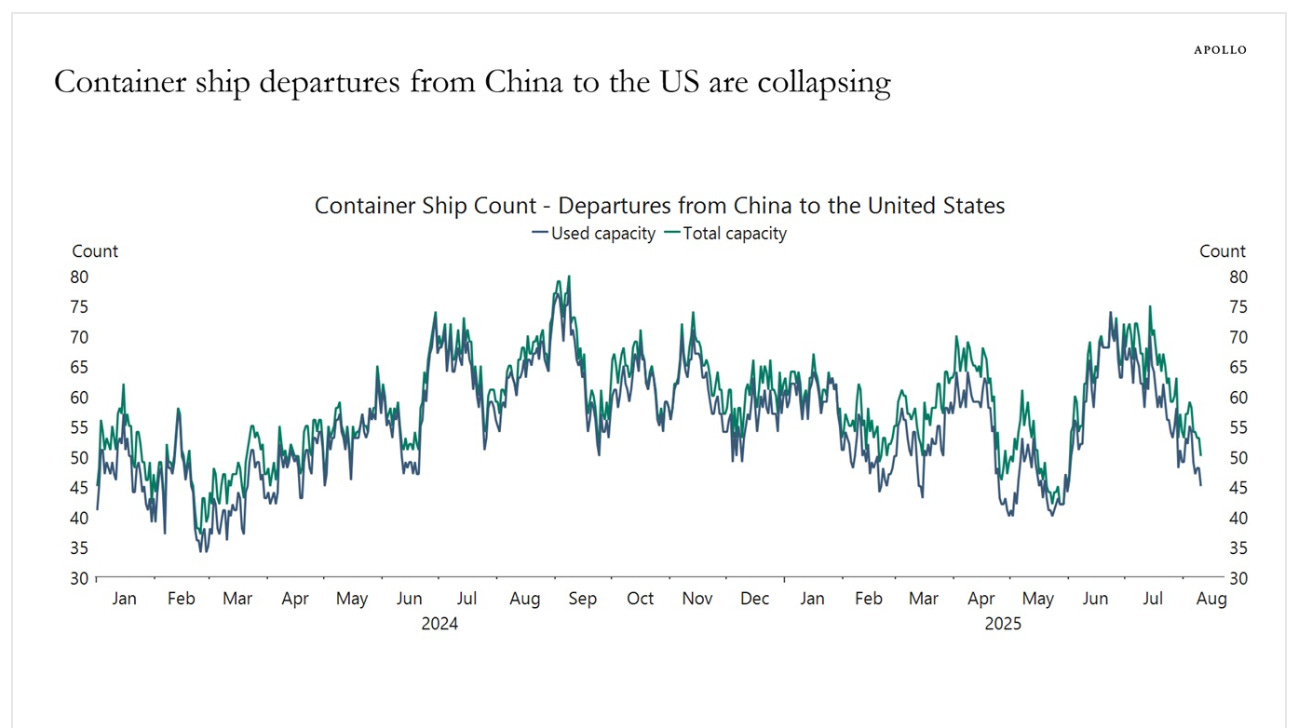
Container ship departures from China to the US are collapsing, see the first chart.
When consumers cannot get the products that they want from abroad, and the products that are imported are more expensive because of tariffs, the outcome is a slowdown in US consumer spending, see the second chart.
The bottom line is that US consumer spending is facing headwinds from tariffs, relatively high interest rates, student loan payments restarting and deportations lowering the number of consumers.
Song Recommendation — Let Me Down Slowly
Quote of the Day
“By three methods we may learn wisdom: First, by reflection, which is noblest; Second, by imitation, which is easiest; and third by experience, which is the bitterest.”
― Confucious