

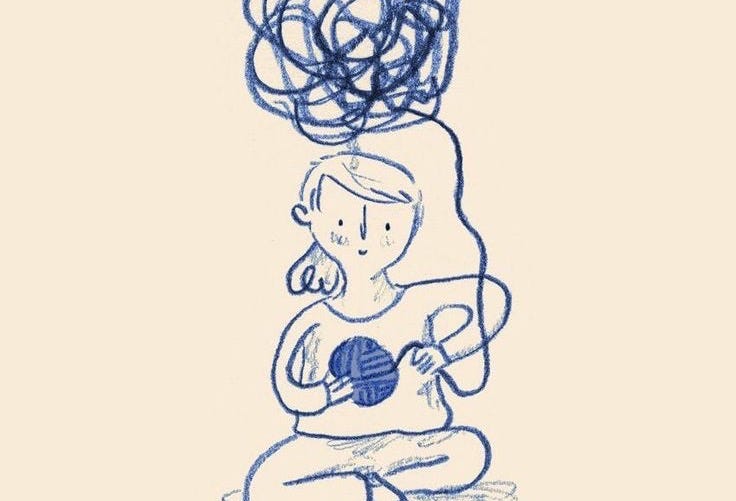
Do you remember the first time you built something? Like the feeling of putting together the Lego set your parents got you when you were a child, piece by piece, until it turned into the Hogwarts castle or the Star Wars R2-D2 on the cover of the box?
Like many grown-ups, I hadn’t felt that in a while, living a life constantly bombarded by work, school, other “obligations” and doomscrolling. A few months ago, though, I rediscovered that spark. My girlfriend and I built a set of Lego roses, the kind you’d see boyfriends carrying down the street on Valentine’s Day. It was the first time in a while that I was able to let my mind go quiet and simply use my hands to put all the pieces together, one by one, combining the stems, thorns and petals until they turned into a beautiful bouquet.
It seems like young adults’ interest in (and obsession with) arts and crafts, toys, baking and cooking has ballooned over the past few years. You don’t have to look any further for evidence than the significant growth in Lego’s sales since the pandemic. From 2019 to 2025, the company’s revenue grew at a compound annual rate of about 14%, more than doubling, with adult fans widely credited as a big driver. Anecdotally, many of my friends have taken up “grandma hobbies” like painting, knitting, baking and cooking. So what’s been driving this boom in leisure activities among young adults?
The age of information we live in today is defined by speed. A forest fire can break out in Australia, and within minutes you’ll hear about it all the way in Canada. This speed of communication, and the constant flow of information made possible by the internet and social media, has made the world feel extremely chaotic, adding to a sense of uneasiness and anxiety. This uneasiness could stem from anything, like concerns about the safety of koalas, which lipstick or shoe color you should be buying and, God forbid, with the rise of AI, anxiety over job security (is AI going to replace my job?) and even human extinction.
On a more personal level, the speed of information can also instill a sense of uneasiness, like the fear of missing out (FOMO) you get watching your friends’ stories on a Friday night, which makes you question whether staying home was really the best decision. According to a survey by Deloitte, a consulting firm, about 4 in 10 Gen Zers say they feel stressed or anxious most or all of the time, and a 2026 survey by YPulse, a youth research firm, found that social media and the internet are young people’s top source of anxiety. The irony is that much of this anxiety is self-induced: going on your phone is a choice, and so is indulging in endless stimulation. Let’s be honest. When was the last time you put your phone down… and actually… got bored?
And I think that is where the problem is: our free time is dominated by screen time because we don’t know what to do with boredom (boredom can feel lonely, too). But the good news is that our exhaustion with the overconsumption of social media is inspiring creative alternatives. One of my friends, Ingrid, who works as an engineer, has recently picked up knitting. Instead of spending hours watching Netflix or scrolling reels, Ingrid and I hopped around the city to fabric shops to source the yarn for her latest project, a scarf for her boyfriend. She sometimes works on the scarf during her commute or before she goes to bed, sort of like an old granny, if you ask me.
But Ingrid absolutely loves it! She loves how knitting fills up her free time, gives her something to look forward to working on every day, lets her see her progress, and makes her feel less stressed. What Ingrid experiences aligns with research findings. In a survey of more than 3,500 knitters, Riley, Corkhill and Morris (2013) found that knitting more often was linked to feeling calm and happy, and that these positive effects may be amplified when people knit in a group. Two theories may explain this. The first is what Harvard cardiologist Herbert Benson called the “relaxation response,” in which repeating a word, sound or movement slows your heart rate, breathing and metabolism, the opposite of fight-or-flight. Benson even named knitting as one way to trigger it.
The second theory argues that crafts, being both visual and physical, take up enough of our attention to squeeze out mind-wandering, and a wandering mind tends to be an unhappy one. Harvard researchers Killingsworth and Gilbert (2010) used an app to check in with 2,250 people at random moments and found that people’s minds were wandering almost half the time, and that they were less happy when that happened. Visual tasks may be especially good at blocking the vivid mental replays anxious people get. In experiments by Oxford psychologist Emily Holmes and colleagues, playing Tetris, a video game, after watching a distressing film reduced later flashbacks. A later emergency-room trial with people who had just been in car crashes found that Tetris cut unwanted memories of the crash by 62% over the following week.
For me, the recent obsession has been with cooking pasta. I devoted the past week to understanding the technique of cooking rigatoni alla vodka, and discovered the simple joy of putting a handful of seemingly ordinary ingredients (my recipe: tomato paste, gochujang, garlic, onion, chili paste, some black pepper, Parmesan cheese and a burrata on top) together into something incredibly tasty. If I’m feeling lazy, a jar of Rao’s or Carbone sauce does most of the job.
Throughout this process, I really discovered the joy of learning the science of emulsion, of trying (and failing at) something new again, and of seeing (and tasting) the results improve over time. It is this sense of building competence that makes me feel content. This is what neuroscientist Kelly Lambert argues: people get a boost from physical effort that produces something, like cooking, gardening or making things.
There’s a bonus, too. In Lambert’s experiments, rats that had to dig for their treats kept trying longer at a stressful, unsolvable task than rats that were simply handed theirs. The digging seemed to teach them that effort pays off, and Lambert thinks hands-on work teaches us the same lesson. Psychologist Albert Bandura made a similar point about people. If we only ever have easy wins (like the instant dopamine hit of scrolling), we come to expect quick results and get discouraged easily when things go wrong. Pushing through obstacles, on the other hand, builds what Bandura called “self-efficacy,” the belief that we can pull off what we set out to do. So when the flavor of my sauce is off and I have to start over, I’m not just making dinner. I’m practicing persistence.
Sure, Ingrid could just buy a scarf, and I could go eat pasta at an Italian restaurant, but that misses the whole point. However inefficient and meaningless the little crafts and skills we pick up may seem, they give us a little space that is truly ours in a world obsessed with speed, efficiency and perfection. In this space, we can be present, make mistakes, experiment, be excited and feel alive again. For me, that means forgetting about the world and just witnessing the pure joy of putting a bunch of random ingredients together and turning them into the most flavorful rigatoni alla vodka, or turning a few hundred random Lego pieces, with the touch of my hands, into beautiful roses. So go on, put the phone down and make something. You might just love it!