

I have never met a single person who is not interested in visiting Japan. The allure is undeniable—Mount Fuji’s snow-capped symmetry, the meticulous craftsmanship behind a Seiko Spring Drive or raw selvedge denim, the ritual of perfectly prepared ramen. It’s a country that has mastered the art of making the ordinary sacred.
But beneath the surface of this aesthetic perfection lies a darker truth, one that became impossible to ignore in the winter of 2025.
In February 2025, Japan’s Ministry of Health, Labor, and Welfare released statistics that came as a surprise to nobody. The number of births in 2024 had fallen to 686,061, the first time in recorded history that the figure dropped below 700,000. It marked the ninth consecutive year of decline, accelerating 15 years ahead of expert predictions. The natural population decline hit a record 919,237. Deaths climbed to 1,605,298. During the first baby boom following World War II, Japan saw 2.5 million births annually. Now, fewer than 700,000 new lives arrive while the grave claims over 1.6 million. The total fertility rate fell to 1.15. In Tokyo, it dipped to 0.96.
These aren’t just statistics. They’re the death rattle of a society that has stopped believing in the future.
The timing of these demographic revelations coincided with another crisis. In October 2025, Japan elected its first female prime minister, Sanae Takaichi, a hardline conservative protégé of the late Shinzo Abe. Her historic ascension should have been cause for celebration. Instead, it triggered a market convulsion. Takaichi had campaigned on “responsible and proactive” fiscal expansion—a proposed two-year suspension of the 8% consumption tax on food, higher defense spending, and aggressive industrial policy. The market’s response was brutal. Japan’s 10-year government bond yield pierced 4% for the first time in decades.
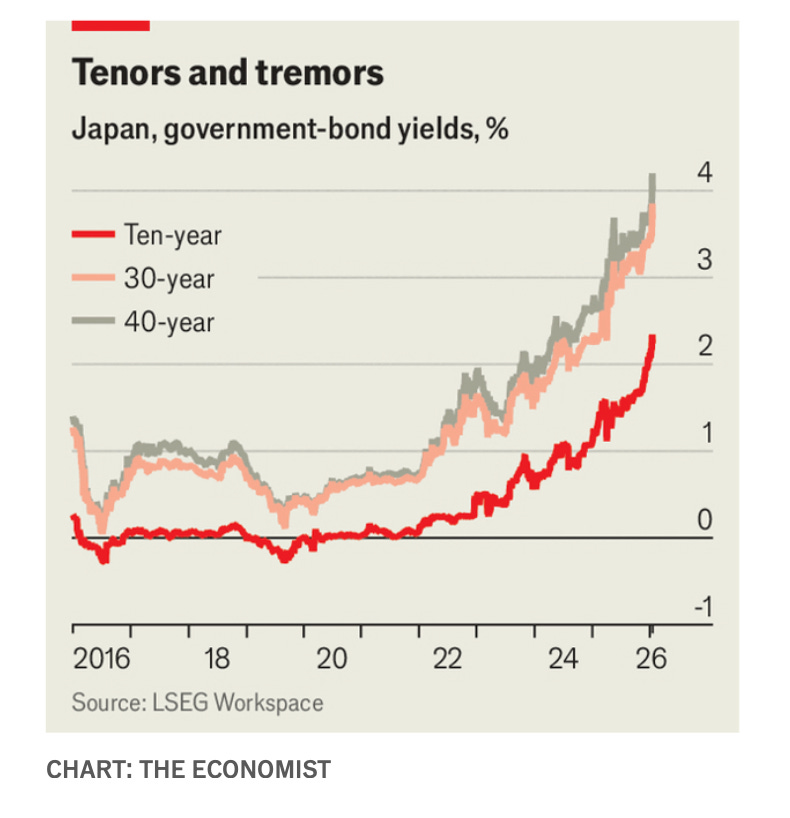
The skepticism was warranted. Japan’s government debt stood at approximately 235% of GDP as of March 2025. The Bank of Japan alone held 46.3% of government debt. Japan’s economy had finally begun normalizing after decades of deflation, and the central bank was poised to raise rates. Takaichi’s expansionary fiscal policy and the bank’s tightening monetary policy were on a collision course.
But the real question no one wanted to ask was this: Could fiscal stimulus resurrect a society that had already decided to die?
To understand Japan’s predicament, you have to travel back to 1989, the year the bubble burst. Between 1989 and 1992, the Nikkei 225 plummeted over 60%. Urban land prices collapsed by 15-20%. The country entered the “Lost Decades,” a prolonged stagnation from which it never truly recovered. In response, policymakers turned to quantitative easing, turbocharged under Abe into “Abenomics” in 2013. The policy boosted stock markets, but Japan’s debt burden soared past 200% of GDP and kept climbing. The fundamental issue: monetary and fiscal interventions were treating symptoms rather than causes rooted in culture and institutions.
I visited Japan briefly last winter, in Tokyo. What struck me most was the overwhelming sense of order and hierarchy. The conformity was immediately visible on the subway—everyone dressed in neutral colors, the styling remarkably uniform. I thought about the New York City subway, a kaleidoscope of chaos. In Tokyo, you could feel the weight of social expectation pressing down.
One evening at midnight, I found myself eating katsu don at a small restaurant. Two men in business suits sat nearby, hunched over laptops, still grinding away at work. Locals confirmed that the culture of endless work hours still permeates Japanese society. But the most jarring discovery was the women-only train cars—existing because groping and harassment on crowded commuter trains is persistent enough to warrant segregated transportation. While some celebrate this as advancing women’s safety, it struck me as a symptom of a deeper pathology.
A Japanese friend once explained this paradox: “Japan only evolves during times of crisis. When the threat of imminent danger fades, we stagnate.” The country functions like a single-minded organism. As anthropologist Ruth Benedict wrote: “The Japanese, more than any other sovereign nation, have been conditioned to a world where the smallest details of conduct are mapped and status is assigned...they learned to identify this meticulous plotted hierarchy with safety and security.”
But what happens when that world no longer offers a future worth participating in?
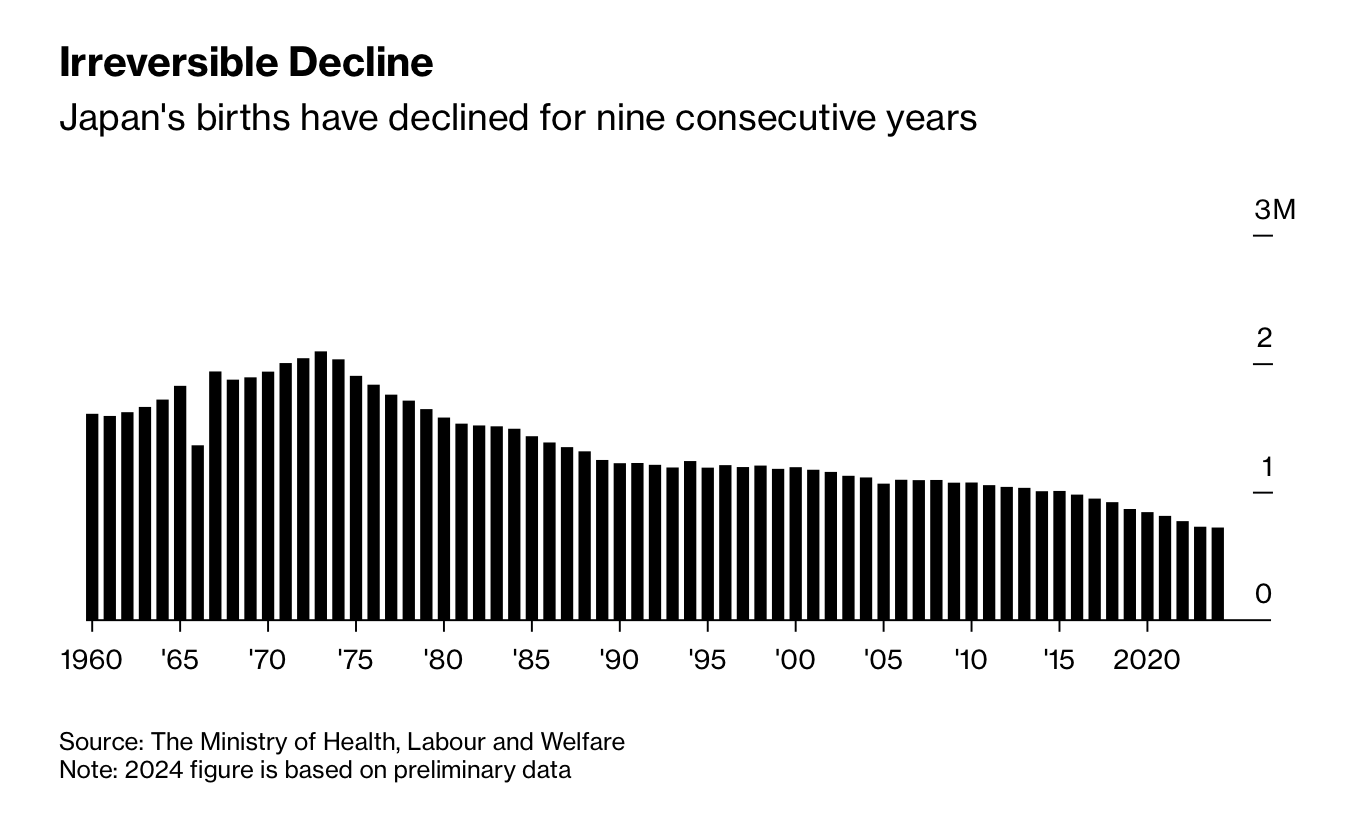
In macroeconomics, the household is the basic unit of measurement. It’s where consumption happens, where future workers are born and raised. The formation of households builds social capital that translates directly into economic capital. So why have Japanese people stopped forming households?
Japan’s working-age population peaked in 1995 and has been declining ever since. Despite government policies aimed at encouraging childbearing—subsidies, expanded childcare programs, aggressive matchmaking support—births continue to fall. While marriages edged up 2.2% to 499,999 in 2024, this came only after steep declines. And unlike in Western countries, only a few out of every 100 babies in Japan are born out of wedlock.
The reality is that many Japanese people, particularly young people, are engaging in passive resistance. They’re opting out through the quiet refusal to participate in the traditional life script: career ladder, marriage, children, retirement. This isn’t laziness. It’s a rational response to a system that demands total conformity but offers diminishing returns. Long work hours, rigid hierarchies, limited career mobility for women, social stigma around alternative lifestyles, astronomical costs of living—all compound into a simple calculation: Why bother?
When a society makes the basic act of family formation so difficult, so financially precarious, so socially constrained that large swaths of the population simply opt out, you’re witnessing the slow collapse of collective will.
Enter Takaichi in October 2025, promising a revival through fiscal firepower. But Abenomics already ran this experiment for nearly a decade. It boosted stock prices, weakened the yen, kept the government afloat. What it didn’t do was address the fundamental problem of a society whose institutions and cultural values are frozen in amber, unable to adapt to new realities.
The most apt comparison is to a patient with chronic illness who doesn’t believe treatment will work. Without the patient’s active participation in recovery, nothing changes. Takaichi’s fiscal expansion will likely follow Abe’s trajectory, led by temporary market reactions, mounting debt, and no fundamental shift in demographic trends. You cannot spend your way out of a crisis of meaning and purpose.
Economics is rooted in culture and institutions. When those cultural values and institutional structures calcify rather than adapt, economic policy becomes like painting over rust. It might look better temporarily, but the underlying decay continues. Japan’s future, absent fundamental transformation, is one of continued population decline, mounting debt, and a society that grows grayer in every sense. Not through catastrophe, but through the quiet withdrawal of a population that has collectively decided there’s no future worth investing in.
Some observers call this “late-stage capitalist decline.” I think it’s what decline looks like in general. Decline is when a society becomes unable to evolve, when it constrains its ability to voice dissent and innovate. Decline is when social norms are challenged but unsuccessful. Decline is passive resistance writ large—the decision to stop playing the game entirely.
Japan’s tragedy is particularly poignant because the country has so much to offer. The craftsmanship, the aesthetic sensibility, the emphasis on quality and care. But they’ve become trapped in a social structure that punishes deviation and rewards conformity to the point of self-destruction.
The country is becoming what I saw on that subway. A sea of black and gray, individual color drained away; everyone moving in the same direction toward a destination nobody really wants to reach.