

World Events — Xi’s Futile War on Price War
Economists
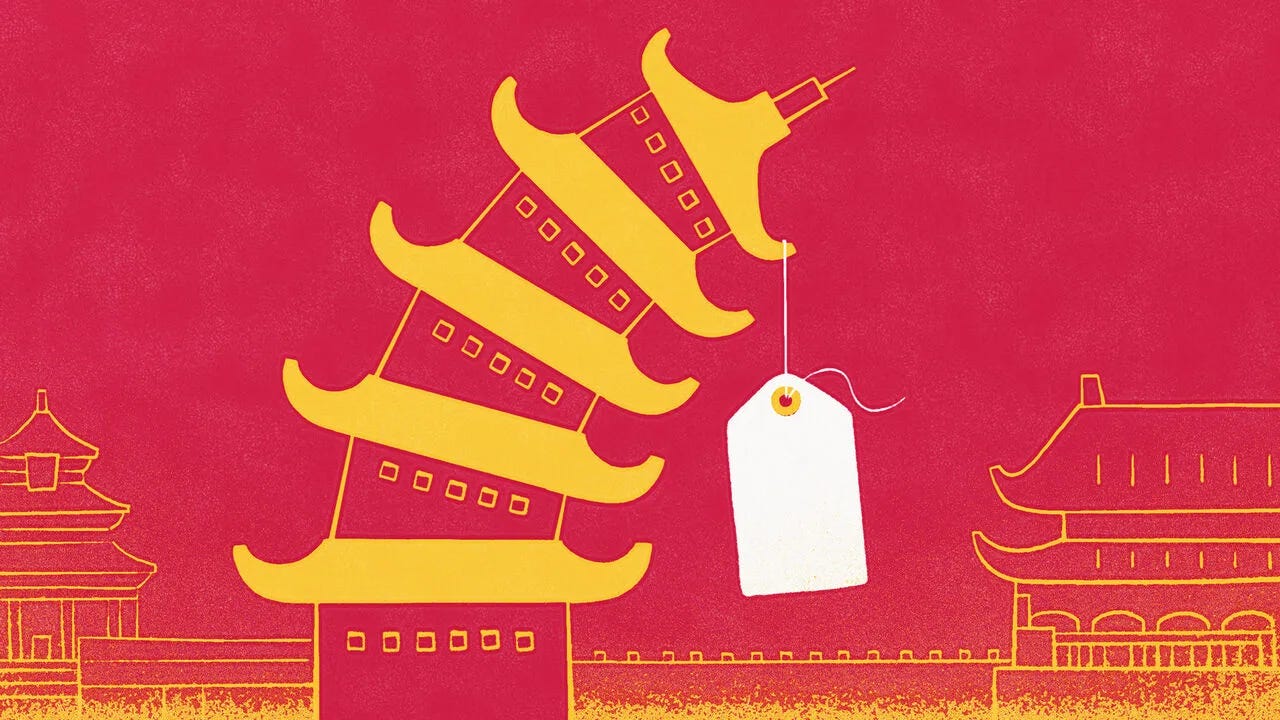
China’s current economic predicament is marked by persistent deflation and a phenomenon described as “involution,” where intense competition among firms results in falling prices and profits without corresponding gains for workers or the broader economy—most acutely in industries like electrical machinery, steelmaking, and non-metallic mineral products, but also evident in sectors such as autos and tobacco. This situation has been exacerbated by government policies that, while aiming to maintain China’s industrial prowess and promote new growth sectors like electric vehicles and solar panels, have inadvertently encouraged local governments and firms to duplicate efforts and overproduce, leading to excess capacity and downward pressure on prices. Despite past successes with supply-side structural reforms that curbed overproduction and boosted profitability in state-dominated industries, today’s private-sector-led industries are less amenable to top-down controls, and efforts to address the problem are complicated by weak consumer demand, high household savings, and a faltering property market, all of which make it difficult to rebalance the economy and restore healthy growth.
Tech — Microsoft Claims Its Diagnostics Outperforms Doctors

FT
Microsoft recently unveiled its AI-powered diagnostic tool, the Microsoft AI Diagnostic Orchestrator (MAI-DxO), developed by a new health unit led by former DeepMind co-founder Mustafa Suleyman, which is reportedly four times more accurate than human doctors at diagnosing complex medical cases, according to company claims. The system employs a unique “orchestrator” that coordinates five AI agents, each simulating a doctor’s role in diagnosing patients, and uses a “chain of debate” technique to explain its reasoning step-by-step. Tested on 304 challenging case studies from the New England Journal of Medicine, the tool—especially when combined with OpenAI’s o3 reasoning model—achieved an 85.5% accuracy rate compared to about 20% among experienced doctors (who, in the trial, could not consult resources or colleagues). While Microsoft suggests this technology could soon be integrated into its Copilot chatbot and Bing search engine, experts caution that it is still in early development, has not been peer-reviewed, and is not yet ready for clinical use, despite its promise to reduce healthcare costs and improve diagnostic efficiency.
Business — Gap’s New Strategy

Bloomberg Businessweek
Gap, once a dominant force in American retail, has struggled for decades with declining sales, leadership turnover, and self-inflicted missteps, but under CEO Richard Dickson, there are signs of a potential turnaround—if the company can navigate new tariff challenges and refocus on its core strength: making cool, affordable clothes. As the Trump administration’s tariffs threaten to add up to $300 million in costs for Gap in 2025, Dickson and his team are working to diversify suppliers, reduce reliance on China, and increase American-grown cotton, all while maintaining patience and momentum in a tough market. Despite a history of failed ventures and shifting strategies, recent efforts to clean up finances and logistics have coincided with renewed interest from both young shoppers and nostalgic older customers, hinting at a revival. With its scale, longstanding supplier relationships, and iconic brand legacy, Gap may be better positioned than smaller competitors to weather industry disruptions—provided it can recapture cultural relevance and deliver the clothes people want, a challenge Dickson seems determined to meet as he steers the company into its next chapter.
Culture — Japan’s Civil War Over Surname

Economists
Japan’s ongoing debate over married surnames, often described as a “civil war,” spotlights the clash between traditionalist values and modern demands for gender equality and individual identity, as inventive couples like Uchiyama Yukari and Koike Yukio repeatedly divorce and remarry to avoid the legal requirement that spouses share a single surname—a law that, while not specifying which partner must change their name, results in women taking their husband’s surname in 95% of cases. Despite strong public support for reform—with surveys showing a majority of Japanese favor relaxing the rule—and compelling arguments from activists and business leaders that the current system hinders women’s advancement, allows rare surnames to disappear, and discourages marriage and childbirth, political inertia prevails due to resistance from the ruling Liberal Democratic Party’s conservative wing, who argue that changing the law would confuse children and weaken family bonds. The issue has become a touchstone for Japan’s political right, with some even framing reform as a threat to national identity, leaving progressive voices frustrated as creative workarounds and persistent advocacy continue to challenge the status quo in a society increasingly at odds with its own traditions.
The Daily Spark
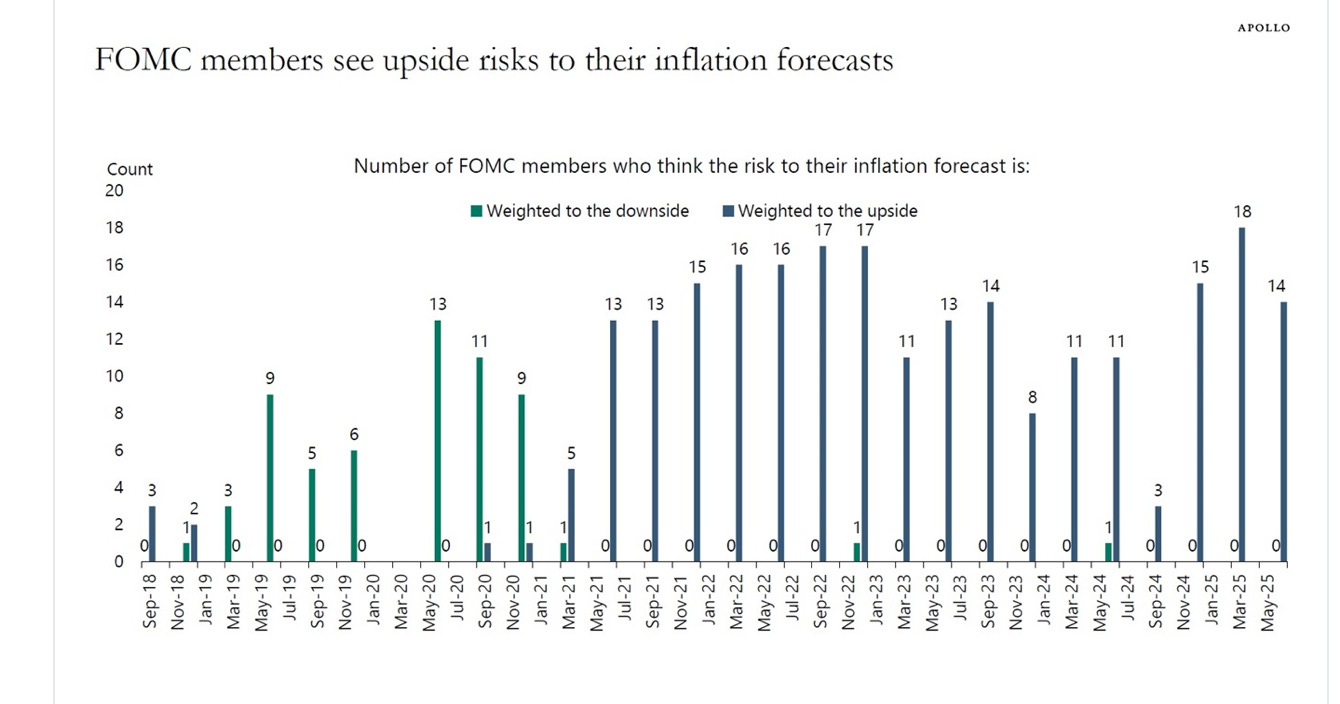
When FOMC members produce their forecasts ahead of Fed meetings, they are also asked how they view the risks to inflation and unemployment.
Currently, there are no FOMC members who foresee downside risks to the unemployment rate or inflation, see charts below.
In other words, the Fed continues to forecast stagflation and is concerned that we may experience rising inflation and rising unemployment at the same time.
These worries are likely driven by higher oil prices, tariffs, and immigration restrictions, all of which are putting upward pressure on inflation and unemployment simultaneously.
Song Recommendation — 10AM
Quote of the Day
“All that is gold does not glitter,
Not all those who wander are lost;
The old that is strong does not wither,
Deep roots are not reached by the frost.
From the ashes a fire shall be woken,
A light from the shadows shall spring;
Renewed shall be blade that was broken,
The crownless again shall be king.”
― J.R.R. Tolkien, The Fellowship of the Ring