❓What Happens When Economic Reality Rewrites the Social Contract?
Today’s stories reveal a common thread: the old rules no longer apply, and an entire generation is rejecting systems that promised prosperity but delivered precarity instead. From young New Yorkers electing a democratic socialist mayor to Canadians demanding structural reform to women hiding boyfriends because partnership feels like settling, we’re watching economic anxiety reshape politics, policy, and even romance—creating new divides between young and old, men and women, and those who adapt versus those left behind.
🏛️ Politics — Why a 34-Year-Old Democratic Socialist Just Won NYC: It’s About Generational Economics, Not Ideology

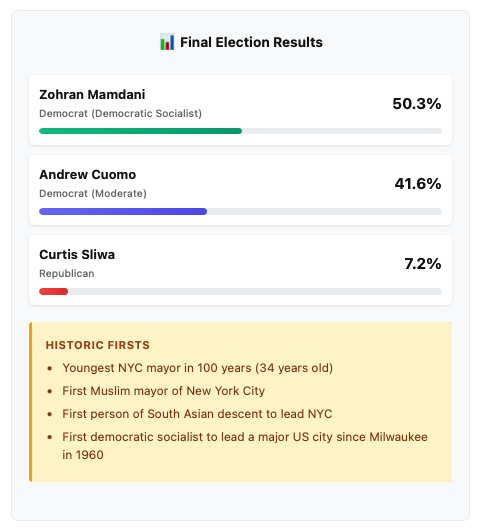
Zohran Mamdani made history on November 4, 2025, by winning New York City’s mayoral race with 50.3% of the vote, defeating former Governor Andrew Cuomo (41.6%) and Republican Curtis Sliwa (7.2%). At 34, Mamdani will become the youngest NYC mayor in a century, as well as the city’s first Muslim mayor and first person of South Asian descent to lead it.
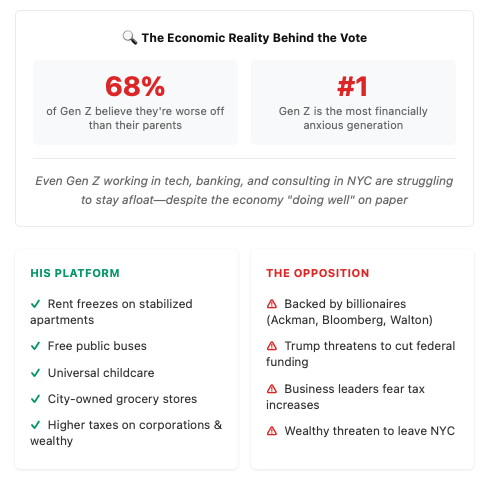
The democratic socialist state assemblyman from Queens ran on an ambitious progressive platform promising rent freezes on stabilized apartments, free buses, universal childcare funded by new taxes on corporations and high-earners, and city-owned grocery stores. His grassroots campaign energized young voters and leveraged small-dollar donations matched by the city’s generous public funding program, overcoming opposition from business leaders and wealthy donors who backed Cuomo.
Mamdani will face immediate challenges managing relations with President Trump, who has called him a “communist lunatic” and threatened to withhold federal funding from the city.
💡 WHY THIS MATTERS
This isn’t about the younger generation wanting “communism.” It’s about a generation that’s watched the economy boom on paper while they can’t afford rent in the city where they work. Young professionals in banking, tech, and consulting—jobs that used to guarantee financial security—are drowning in student debt, priced out of homeownership, and feeling economically worse off than their parents despite “doing everything right.”
Mamdani won because he spoke to their lived reality. While Cuomo and establishment Democrats talked about economic growth and business-friendly policies, Mamdani talked about rent, childcare costs, and the fact that the system isn’t working for people under 35. He didn’t win on ideology—he won on representation and relatability.
This is the blueprint for the next decade of politics. Mamdani leveraged social media to speak directly to young voters’ concerns, bypassing traditional media gatekeepers. Whether he succeeds or fails as mayor, expect to see more candidates following this playbook: Be young, be online, be outspoken about generational economic anxiety, and don’t sound like a politician.
🤖 Tech — Australia Bans Social Media for Kids Under 16—A Blueprint for the World?
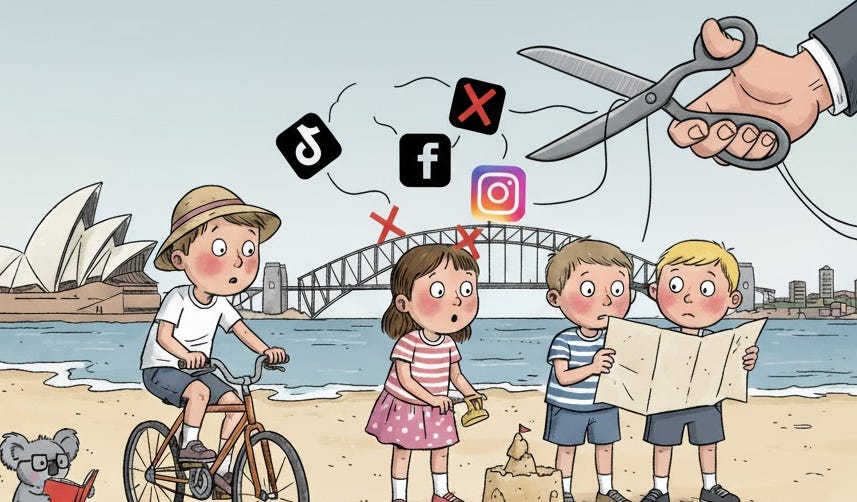
Australia’s social media ban for under-16s, effective December 10, represents a watershed moment in addressing what many see as a generational crisis. The ban works by requiring platforms like Facebook, Instagram, TikTok, and YouTube to prevent children under 16 from creating accounts through age verification methods including document checks, biometric analysis, and behavioral patterns. Companies face fines up to A$49.5 million for breaches, though they only need to take “reasonable steps” to comply.
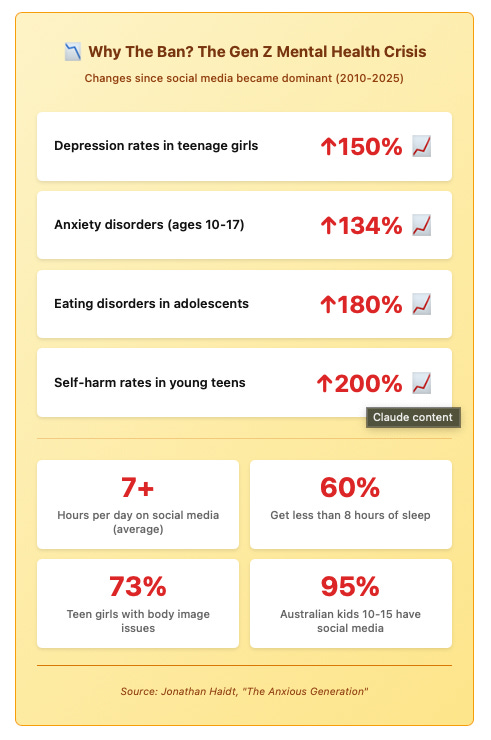
While the government acknowledges the system won’t be perfect, this move reflects a growing global consensus that something must be done. Today’s youth are the first generation to grow up entirely immersed in social media, and the damage is undeniable: skyrocketing rates of self-image issues, depression, eating disorders, and social anxiety.
Sociologist Jonathan Haidt captured this crisis in “The Anxious Generation,” arguing that Gen Z’s constant digital immersion has fundamentally impaired their ability to socialize and develop healthy relationships. Australia’s ban, backed by 77% of its population, isn’t just policy—it’s an intervention to give childhood back to children, allowing them to develop without the manipulative algorithms and toxic comparison culture that have defined their older peers’ formative years. This could be a genuine win for the next generation.
📈 The Markets — Canada’s New Budget
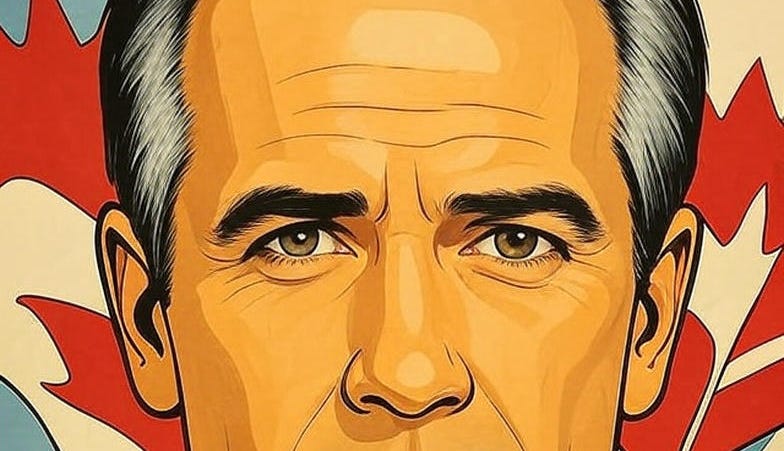
Canada’s new budget under Prime Minister Mark Carney projects C$167.3 billion in additional deficits over five years, driven by massive capital investments in defense, housing, infrastructure, and trade projects aimed at helping Canada diversify beyond US markets amid Trump’s tariff war. The budget pegs this year’s deficit at C$78.3 billion (2.5% of GDP) with C$60 billion in operating spending cuts, while maintaining the debt-to-GDP ratio around 42-43%—still the lowest in the G7. Though analysts call it more “incremental” than transformative, this budget represents another step in Carney’s broader agenda to address Canada’s deep-rooted economic malaise that extends far beyond Trump’s tariffs.
The external shock has merely exposed what many Canadians have lived for years: a sclerotic economy strangled by bureaucratic red tape, chronic brain drain to the US, youth unemployment hovering at alarming levels, and housing costs that have made homeownership a distant fantasy for an entire generation. These pressures have sparked a political reckoning, forcing policy shifts including tighter immigration controls, aggressive trade diversification away from US dependency, initiatives to attract and retain foreign talent, and the scrapping of Trudeau-era environmental restrictions on mining and oil development.
Carney’s budget continues this course correction with accelerated business investment writeoffs and infrastructure spending designed to finally unlock productivity growth. For young Canadians who’ve watched their economic prospects dim while government dysfunction persisted, these measures signal a long-overdue recognition that structural reform—not just spending—is essential to building an economy where they can actually thrive.
💃 Culture — Men Are Falling Behind and Women Are Done Pretending: The Economic Reality Behind Heterofatigue

A curious trend has emerged on social media where straight women are obscuring their boyfriends’ identities in posts—blurring faces in wedding photos, cropping partners out of videos, or only showing hands and silhouettes—reflecting what appears to be a cultural shift where having a boyfriend has become fundamentally uncool.
This represents women trying to straddle two worlds: reaping the social benefits of being partnered while avoiding the “culturally loser-ish” label of being boyfriend-obsessed, especially in an era of widespread “heterofatalism” where openly celebrating heterosexual relationships feels almost embarrassingly normie or even “Republican.” Content creators report losing hundreds of followers after hard-launching boyfriends, with audiences commenting that “boyfriends are out of style” and partnered women admitting their content becomes “more beige and watered-down” in relationships.
The shift signals a politicization of straight women’s identity, where being single has transformed from a cautionary tale into a desirable, even superior status—a flex that affirms independence rather than the traditional narrative where partnership validated womanhood. As heteronormativity crumbles and women romanticize single life, having a boyfriend has become a “fragile, even contentious concept,” marking the end of a centuries-old heterosexual fairytale that arguably never benefited women in the first place.
💡 WHY THIS MATTERS
This isn’t about women suddenly hating men or some trendy feminist awakening. It’s about a generation of women who’ve outpaced men economically while still being told to marry up. Young women are graduating college at higher rates, buying homes earlier, saving more, yet they’re expected to date men who increasingly can’t meet the traditional standards they’ve been socialized to want. The Economist’s article Why female pop stars are lambasting mediocre men captured this perfectly: artists like Sabrina Carpenter are writing songs like “Man Child” mocking male mediocrity because that’s the dating reality for millions of educated women.
The economy has fundamentally restructured in ways that favor traits traditionally coded as feminine—communication, collaboration, emotional intelligence, educational attainment—while men haven’t adapted. The result isn’t just cultural; it’s a crisis of compatibility. Women are hiding their boyfriends online not because they’re embarrassed by love, but because admitting partnership in this environment feels like settling, like accepting less than what their own economic achievements would suggest they deserve.
This is the real story behind “heterofatigue” and why being single has become a flex. It’s not ideology, it’s economics dressed up as culture. Women aren’t rejecting relationships; they’re rejecting the poor return on investment that modern heterosexual partnerships increasingly represent. When you’re more financially stable, better educated, and more emotionally mature than most available partners, why wouldn’t you celebrate staying single?
The social media trend is just the visible symptom of a deeper economic incompatibility that’s driving men and women apart. And until men catch up economically or society stops expecting women to marry their equals or betters, expect this divide to widen.
📊 Chart of the Day
🎸 Song Recommendation — A Couple of Minutes
💬 Quote of the Day
“People don’t get depressed when they face threats collectively; they get depressed when they feel isolated, lonely, or useless.”
― Jonathan Haidt, The Anxious Generation: How the Great Rewiring of Childhood Is Causing an Epidemic of Mental Illness