

World — Modi Could Get Cornered on Trade By the White House
Bloomberg
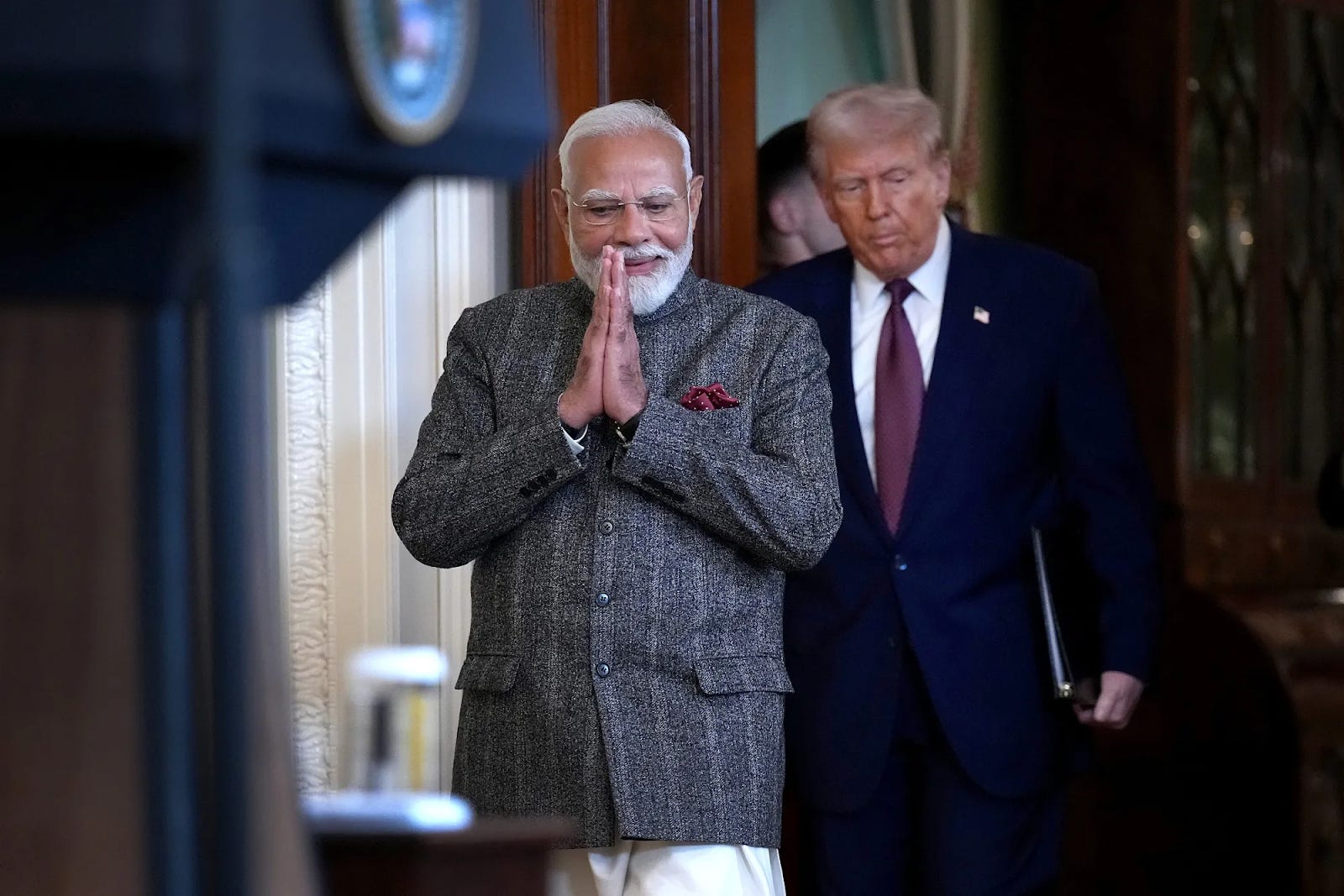
Donald Trump’s public claim that he used trade threats to broker the India-Pakistan ceasefire has put Indian Prime Minister Narendra Modi in a politically awkward position, exposing him to domestic criticism and raising uncomfortable questions about India’s autonomy in both foreign policy and trade negotiations. While Trump and the U.S. State Department have repeatedly asserted that Washington played a decisive role in mediating the truce-specifically by leveraging the threat of new tariffs-India’s government has firmly denied any such linkage, reiterating its long-standing policy that all dealings with Pakistan are strictly bilateral and that trade did not feature in ceasefire talks. The optics of the U.S. president taking credit for peace in South Asia, and tying it to economic concessions, have fueled opposition attacks on Modi for appearing to prioritize trade over national security and for allowing external powers to intrude on India’s diplomatic space. Meanwhile, the looming expiration of a temporary U.S. tariff suspension threatens to saddle Indian exports with a 26% duty, further weakening New Delhi’s hand in trade talks and making it harder to promote India as a manufacturing alternative to China. With negotiations ongoing but the U.S. holding most of the leverage, Modi faces mounting pressure at home to defend India’s interests without appearing to capitulate to American demands or letting Washington dictate the narrative on the subcontinent’s security and economic priorities.
Tech — All Eyes on Computex
Bloomberg
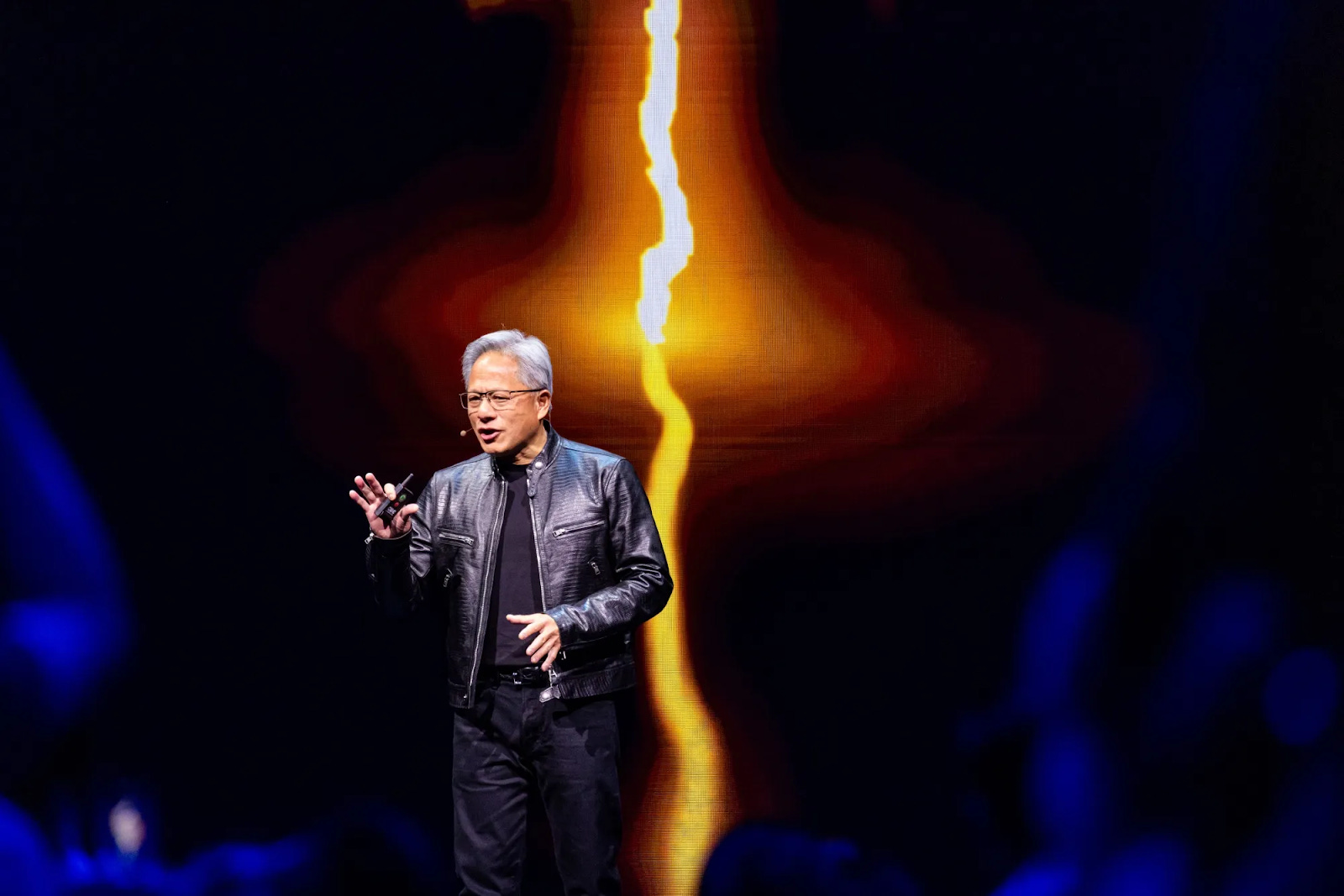
The 2025 Computex conference in Taipei is set against a backdrop of profound industry shifts, with Nvidia CEO Jensen Huang headlining an event that now grapples with both the promise and uncertainty of artificial intelligence and a rapidly changing global trade landscape. While Computex has traditionally showcased cutting-edge AI hardware-such as Nvidia’s chips and Foxconn’s server assemblies-this year’s spotlight also falls on the Trump administration’s efforts to reshape semiconductor trade, including new tariffs that are accelerating the relocation of manufacturing to the U.S. and opening opportunities in the Middle East. Industry leaders will address skepticism about AI’s real-world impact, as consumer adoption has lagged behind the hype, and concerns about a potential AI investment bubble loom large. Meanwhile, Intel’s new CEO Lip-Bu Tan will work behind the scenes to reassure partners and chart a turnaround for the storied chipmaker, as Foxconn debuts a more prominent role in AI server assembly and robotics. The conference also comes on the heels of a high-profile U.S. delegation to Saudi Arabia-featuring Huang and other tech luminaries-highlighting a relaxation of AI chip export rules and the Middle East’s rising importance in the AI ecosystem. As the industry navigates questions about trade, technology, and the future of AI, Computex 2025 promises to be a pivotal moment for global tech manufacturing and innovation.
Economics — Trump Faces a Tariff Disappointment
The Economists
Donald Trump’s vision of replacing income taxes with a wave of border tariffs-reviving the early 20th-century model of government finance-faces a harsh economic reality: tariffs simply cannot generate the trillions in revenue needed to fund today’s federal government. While Trump touts an “External Revenue Service” that would let tariffs bankroll massive tax cuts for most Americans, economists warn that the costs of tariffs are largely borne by U.S. consumers and businesses, not foreign exporters. Moreover, as new trade deals with Britain and China lower overall tariff rates, the revenue pool shrinks further. Even optimistic projections fall far short of Trump’s trillion-dollar ambitions: independent estimates suggest that, at best, tariffs might yield $140–$290 billion annually-nowhere near the $2.4 trillion currently raised from personal income taxes, let alone the $4.4 trillion forecast for the next decade. High tariffs also risk depressing imports, shrinking the tax base, and triggering foreign retaliation, all of which further undermine revenue. Ultimately, Trump’s plan is a fiscal mirage; tariffs are a volatile, narrow, and economically damaging funding source, ill-suited to support a modern government whose spending now exceeds 20% of GDP-ten times the share when tariffs last paid America’s bills.
Society — Young Chinese Are Turning to Chatbots For Friendship and Love

The Economists
A growing number of young Chinese are turning to AI chatbots and virtual companions for friendship, emotional support, and even romance, as apps like Maoxiang and Xingye attract millions of users seeking connection in a society marked by rising loneliness and intense social pressures. These AI partners, powered by increasingly sophisticated language models, offer empathy, constant attention, and tailor-made personalities-qualities that many users find lacking in real-life relationships. For some, AI companionship is a practical alternative to the time, expense, and emotional complexity of traditional dating, while for others, it fills a void left by shrinking social circles and declining marriage rates. However, this trend is causing concern among Chinese authorities, who worry that the growing reliance on virtual relationships may further depress the country’s already record-low birth rate, as young people opt for digital intimacy over real-life partnerships and family formation.
The Daily Spark
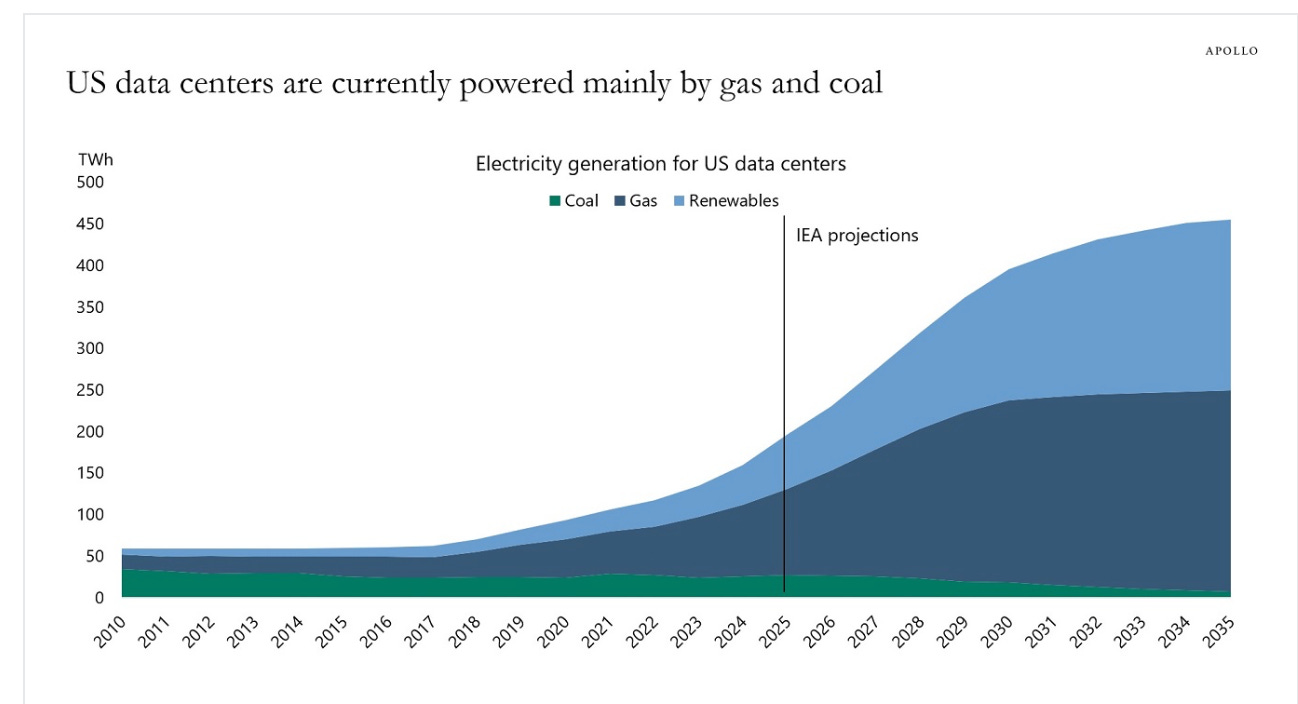
US data centers are currently powered mainly by gas and coal. The IEA is forecasting that this will change over the coming years with renewables playing a much more significant role, see chart below.
Song Recommendation — Old Phone (Ed Sheeran)
Quote of the Day
“My dreams, my dreams! What has become of their sweetness? What indeed has become of my youth?” ― Alexander Pushkin, Eugene Onegin