

You know those girls who always look effortlessly put together? The ones whose outfits hit that perfect sweet spot between “I just threw this on” and “I definitely thought about this”? Yeah, they’re wearing Aritzia.
If you’ve ever seen a Superpuff—that impossibly puffy jacket that dominated campus last winter—you’ve encountered Aritzia. They’re not like Nike, screaming their logo at you. They’re subtle, sleek, chic. And somehow, every girl has clothes from them. The fanbase is cult-like, Lululemon-level obsessive.
I grew up in Vancouver, where Aritzia started. A decade ago, it was just a smaller store without much foot traffic. Now? There are lines out of the changing rooms. Always. And the company’s share price has doubled in 2025 alone.
So what happened? How did a local Vancouver boutique become an international powerhouse in women’s fashion that’s somehow everywhere without being everywhere?
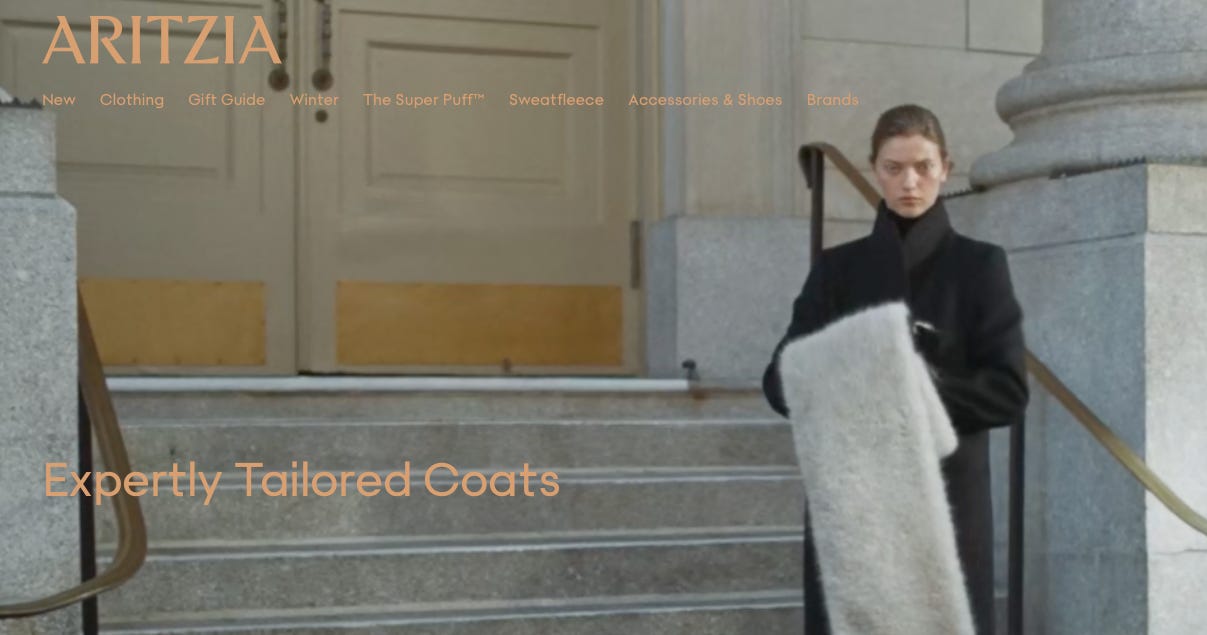
Here is an interesting fact about Vancouver: if a clothing brand starts there, chances are it’s going big. Lululemon. Arc’teryx. Now Aritzia.
The company started in 1984 when Brian Hill opened a single boutique with a simple vision: high-quality, stylish clothing at an affordable price. What they now call “everyday luxury.” From the beginning, they created exclusive in-house brands—Wilfred, Babaton, TNA—giving them total control over design, quality, and pricing.
They spent the next two decades quietly expanding across Canada, building a devoted following among fashion-conscious women. I can confirm this strategy worked. Every girl in my high school wore TNA. I was genuinely confused by the logo because I’d never seen it before—it wasn’t marketed like other brands, it just existed in everyone’s closet. As that clientele got older, they graduated to Wilfred and Babaton, staying loyal to the ecosystem.
Aritzia expanded into the U.S. in 2007 and launched e-commerce in 2012. But what really turbocharged their growth was social media. The Superpuff campaigns. The vegan leather pants that you saw on every influencer a few years ago. Products that looked expensive enough to flex but accessible enough to actually buy.
But here’s the thing: social media didn’t create Aritzia’s identity. It amplified what was already there.
Aritzia figured out something crucial about the fashion market: there was a massive void between fast fashion and luxury that nobody was addressing properly.
On one end, you have Zara, H&M, Uniqlo, Gap, Abercrombie—cheap, trendy, disposable. On the other end, you have Dior, Burberry, luxury houses that cost a month’s rent for a single piece. Aritzia planted themselves right in the middle.
I asked my friend Emily, who shops at Aritzia religiously, to explain the appeal. She called it “expensive basics” that are “simple but still trendy enough for shopping there consistently.” Zara, she said, is “too frilly and excessive.” Aritzia hits the intersection of fashionable, acceptable mid-tier quality, and mid-tier pricing. It’s the Goldilocks zone.
And they reinforced this positioning strategically. They opened stores in premium locations—SoHo in New York, Michigan Avenue in Chicago—to maximize visibility and customer experience. It’s the Canada Goose playbook: position yourself perfectly between the outdoor technical gear (Patagonia, Arc’teryx, North Face) and luxury puffers (Moncler). Fill the gap, own the gap.
But it’s not just Aritzia validating this market. There’s Odd Muse, a British brand founded by Aimee Smale, who worked in fast fashion for years and noticed the same gap—people want higher quality without luxury prices. She created Odd Muse to focus on accessible luxury and investment fashion for young women. It’s not identical to Aritzia—it leans more timeless, which justifies higher price points—but it proves the same thesis that people care about quality and will pay for it.
Artizia enjoyed its best days after the pandemic, which cemented Vancouver’s dominance in fashion. Three brands exploded simultaneously for three different reasons.
Lululemon thrived because of the athleisure boom—everyone working from home in joggers. Arc’teryx surged because people wanted to go outside again and needed technical gear. And Aritzia? Back-to-office dress codes.
Young women needed office attire that looked chic and professional without sacrificing quality. They wanted to impress without dressing like their mothers. And Aritzia nailed that category. Sure, everyone complains about the prices. Everyone grumbles about supposed declining quality. But they keep going back. Just like Lululemon fanatics who swear they’ll stop buying $128 leggings but never do.
The numbers don’t lie. Aritzia saw a 74% increase in net revenue between 2021 and 2022. Revenue has since doubled from 2022 to 2025, hitting over $3.1 billion CAD. The U.S. now represents the majority of revenue. Gross margins expanded from 36% in 2021 to 43% in 2025, showing incredibly disciplined financial management. (This is where you’re feeling the price squeeze, just saying.)
The company carries minimal debt, maintains a healthy balance sheet, and remains deliberate and data-driven in expansion decisions. Strong management execution. Today, Aritzia has a market cap of $13 billion.
Aritzia isn’t revolutionary. Neither is Brandy Melville. Neither are most successful fashion brands, honestly. What Aritzia did was identify a gap in the market and execute on filling it, consistently, relentlessly, store by store, customer by customer.
The early Aritzia I witnessed in Vancouver—the one that didn’t take off—wasn’t the same company. Its explosion was driven by increased demand for the middle segment as fashion became more bifurcated. As fast fashion ran its course, people wanted something better. In fashion, and perhaps life, when you swing to one extreme, you always swing back.
Plenty of brands tried to serve this space. Most failed. Aritzia succeeded because they delivered on their brand promise over and over again (unlike brands like Banana Republic that gradually chose short-term sales over quality) while maintaining financial discipline. They expanded digitally. They opened stores strategically. They built a customer experience that felt premium without being pretentious.
And honestly? They have more room to run.
But here’s a question for you: What’s the next shift in fashion? Because the thing about trends is they never stay still. Fast fashion dominated, then everyone got sick of it. “Everyday luxury” is having its moment now. But what comes after?
My guess? We’re heading toward hyper-personalization and sustainability that actually works. People want quality, yes, but they also want to feel like their clothes reflect who they are, not just what’s trending. They want to know where things are made and how. The brands that crack that code—quality, personalization, and genuine sustainability without the greenwashing—will be the next Aritzia.
Or maybe I’m wrong. Fashion has a way of surprising everyone.
One thing’s for sure though: whatever comes next, it’ll probably start in Vancouver.
-AL
Very insightful article Andy!