

World Events — EU’s Regulation on AI Faces Opposition
FT
The CEOs of 44 major European companies—including Airbus, BNP Paribas, Carrefour, and Philips—have called on the European Commission to impose a two-year pause on the implementation of the EU’s landmark Artificial Intelligence Act, warning that the current complex and overlapping regulations threaten Europe’s competitiveness in the global AI race. Their open letter to Commission President Ursula von der Leyen argues that the Act’s unclear rules jeopardize both the development of European AI champions and the ability of all industries to scale AI in line with international competition. This appeal comes amid mounting pressure from both European startups and major tech companies such as Meta and Apple, who argue that the rushed rollout could stifle innovation, particularly for smaller firms that lack the resources to comply with the Act’s demanding requirements. The EU, which aims to publish a final “code of practice” to guide AI companies before the August 2025 deadline, is reportedly considering adjustments to the timeline and enforcement of key provisions, as many businesses and stakeholders remain uncertain about how to comply with the new rules. Critics fear that, without clearer guidance and more realistic implementation plans, the Act could drive startups and investment away from Europe, undermining the bloc’s ambition to be a global leader in AI.
This makes me think of this quote about the technology landscape right now: America invents it, China copies it, and Europe regulates it.
Tech — Second Mover Advantage

FT
In her Financial Times column, Sarah O’Connor challenges the prevailing narrative that businesses must immediately adopt artificial intelligence or risk being left behind, arguing instead for the merits of the “second-mover advantage.” She notes that while first-movers in AI may reap early benefits—such as shaping new systems to their needs or boosting their reputations—second-movers gain valuable information by observing the successes and missteps of pioneers, allowing them to avoid costly errors and vendor lock-in, especially when AI’s risks and rewards remain uncertain. O’Connor likens the “act now or miss out” rhetoric to high-pressure sales tactics rather than sound business strategy, cautioning that such urgency can stifle innovation by activating fear rather than curiosity among employees. Ultimately, she contends that waiting and learning from others’ experiences can be a perfectly valid—and sometimes superior—strategy, and warns against conflating marketing urgency with genuine strategic necessity.
Perhaps striking the right balance between the two is key.
Trade — US-Vietnam Deal Risks China Reprisal

Bloomberg
The newly announced US-Vietnam trade deal imposes a 20% tariff on Vietnamese exports to the US and a steep 40% tariff on goods deemed to be transshipped through Vietnam—a measure widely interpreted as targeting Chinese products rerouted to bypass US tariffs. Bloomberg Economics warns that this deal significantly raises the risk of Chinese retaliation, as Beijing has repeatedly signaled it will respond to any agreements that undermine its interests. Given China’s status as Vietnam’s largest trading partner and a crucial supplier of manufacturing inputs, any retaliatory steps could have an outsized negative impact on Vietnam’s economy, potentially causing Vietnam to lose up to 25% of its US exports in the medium term and putting more than 2% of its annual economic output at risk. The deal also sets a precedent that other nations may view as undesirable, and it does not address sector-specific tariff concerns central to ongoing negotiations with other major US trading partners.
Culture — Ferrari is the Hermes in the Luxury Car Industry
Economists
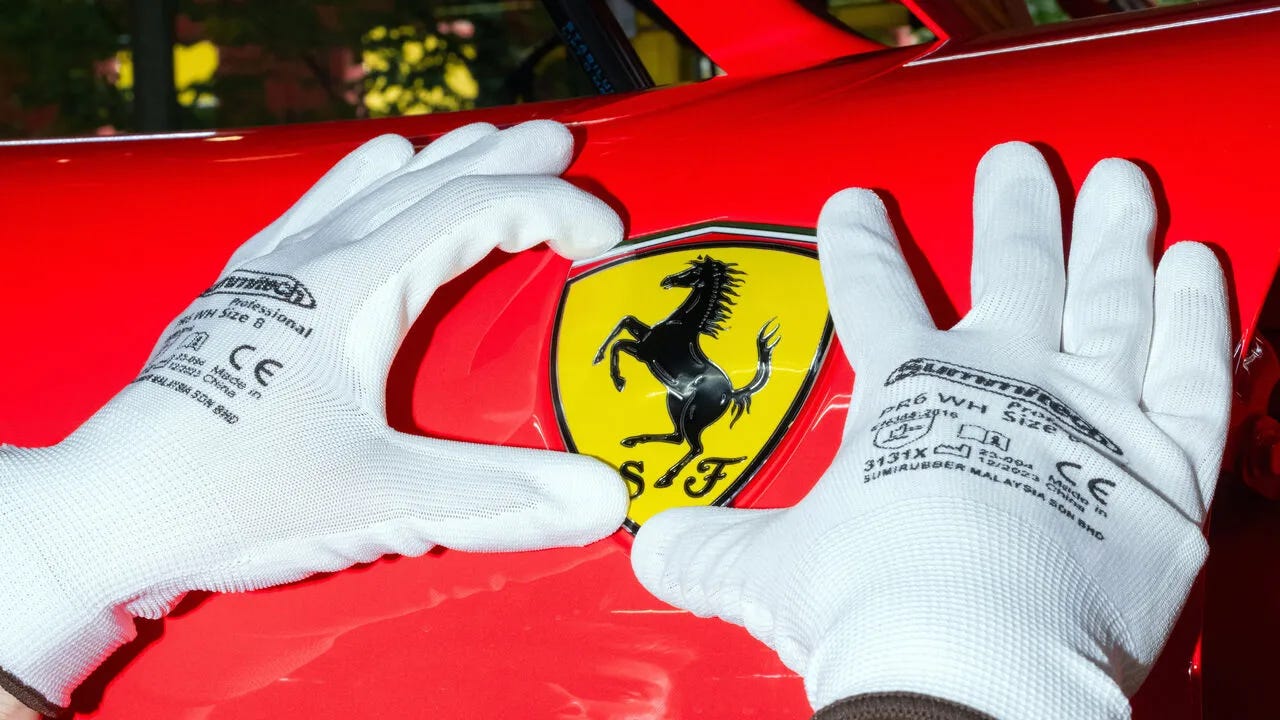
Ferrari is increasingly positioning itself as a luxury brand akin to Hermès, emphasizing exclusivity, craftsmanship, and emotional connection rather than mass-market automotive production. Under CEO Benedetto Vigna, Ferrari has boosted sales and profits while maintaining scarcity, raising prices sharply, and expanding personalization options—traits more typical of ultra-luxury fashion houses than traditional carmakers. The company’s order book is full for two years, and its operating margins far exceed those of mass-market peers. However, Ferrari now faces a pivotal test as it enters the electric vehicle era: its first fully electric model will debut in late 2025, produced in a new state-of-the-art “E-building” in Maranello, with a starting price expected around €500,000, and the brand aims for 60% of its production to be electrified by 2026 and 80% by 2030. Yet, Ferrari has delayed its second electric model to at least 2028 due to weak demand for high-performance luxury EVs, reflecting broader uncertainty about whether the marque’s cachet and pricing power will translate in a market where battery weight, range, and the absence of signature engine sound pose distinct challenges. The electric transition will test whether Ferrari can maintain its aura of exclusivity and desirability as the automotive landscape changes.
The Daily Spark
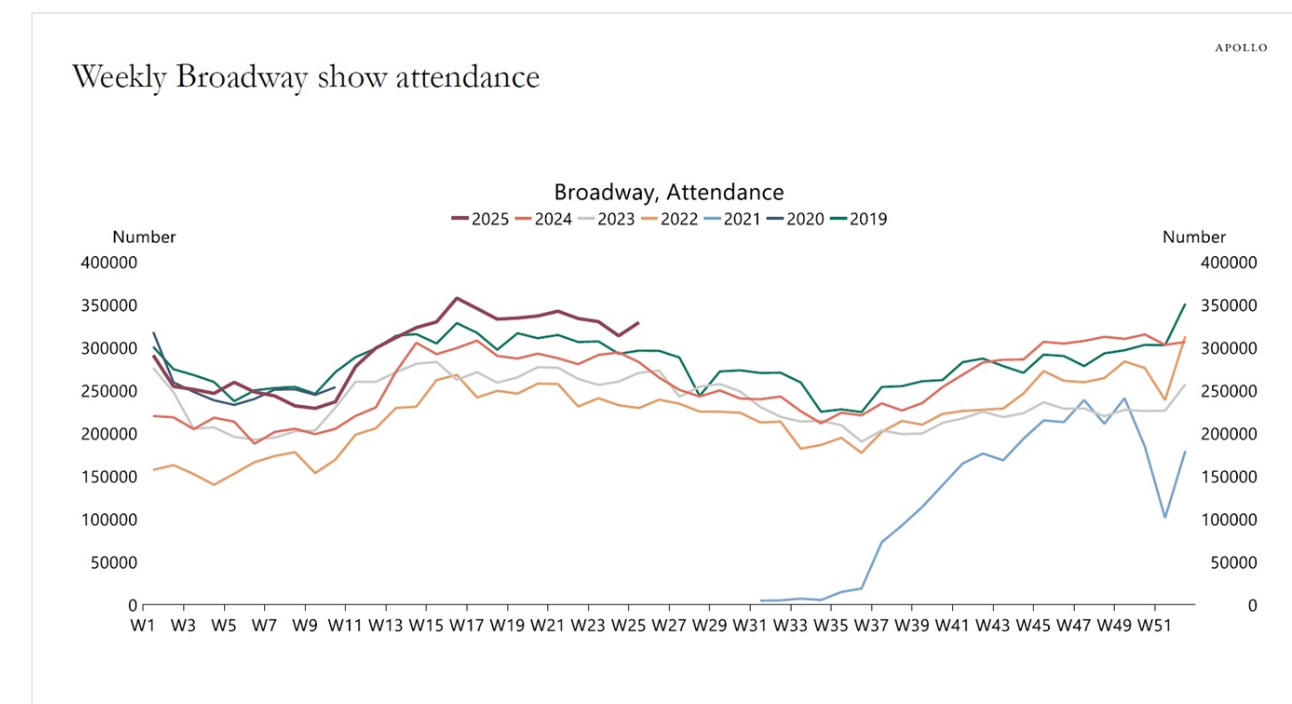
Weekly data for the number of people going to Broadway shows remains remarkably resilient, see chart below.
Song Recommendation — was it easy to forget?
Quote of the Day
“Yesterday is gone. Tomorrow has not yet come. We have only today. Let us begin.”
― Mother Theresa