

You know what’s wild? My therapist told me I should try church.
Not in a “find Jesus” way. In a “you need community and structure” way. I laughed it off at first—I’m not religious, never have been. But then I noticed something. My friends who are religious? They’re going back to church. Not just the devout ones. The casual believers who hadn’t stepped foot in a sanctuary since high school are suddenly showing up to Sunday service.
The data backs this up. Gen Z churchgoers now attend about 1.9 times per month, slightly ahead of Millennials at 1.8—and way more than older generations who’ve been gradually dropping off. This isn’t your grandparents’ religious revival. This is something else entirely.
Here’s the question nobody’s asking: Is Gen Z going back to church because they believe in God, or because they just need to believe in something?
Let’s be honest about what happened. For decades, institutional religion has been dying in the West. As science advanced, as education spread, as the internet gave us access to every philosophical tradition and contradiction, the pews emptied out. This was supposed to be progress—the Enlightenment 2.0. We left the “dark ages” of blind faith and entered the age of reason, human flourishing, unprecedented standards of living.
There’s even research showing that college attendance correlates with lower religiosity, especially for Gen Z. Most people who leave religion do so before 18, but the pattern holds: more education, less church. The story was simple and linear. Religion was a relic. We’d evolved past needing it.
Then COVID happened.
Suddenly, church attendance spiked. Not just in the U.S., but across Western Europe and Canada. People who hadn’t prayed in years were lighting candles. People who rolled their eyes at organized religion were tuning into online services.
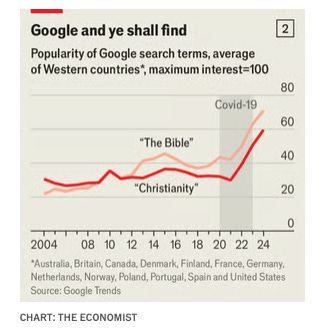
Why? Because nothing was predictable anymore. The economy crashed. People died alone. The future everyone had been planning for evaporated overnight. And when nothing makes sense, when you have zero control, belief in something becomes a lifeline.
I saw this firsthand. I traveled to Sri Lanka during their economic crisis around COVID, and the churches were packed. Not because people suddenly became more devout, but because they needed somewhere to put their fear. Church offered what therapy waitlists and Instagram infographics couldn’t: immediate community, ritual, and the psychological comfort of believing someone—even if it’s God—has a plan.
Psychologists call this a coping mechanism. When you believe you have control, even if it’s an illusion, you take action. You solve problems. You keep going. Religion gave people that feeling when nothing else could.
But here’s where it gets interesting. COVID is over. The acute crisis has passed. So why are Gen Z still showing up?
Because the crisis hasn’t passed. Not for us.
We’re the loneliest generation in recorded history. We’re the first generation expected to earn less than our parents. We’re drowning in student debt, locked out of the housing market, swiping through dating apps where genuine connection feels impossible. We were told that if we worked hard and got educated, we’d be fine. We did everything right, and we’re still struggling.
Therapy helps, sure—if you can afford it. Self-care helps, in theory—until you realize that bubble baths and meditation apps can’t fix structural economic problems.
Church, though? Church is free. Church happens every week.
And here’s what non-religious people often misunderstand: modern church isn’t your grandma’s Sunday service. Walk into a Gen Z-heavy congregation and it’s filled with twenty-somethings in hoodies, drinking coffee, trying to figure out their lives. It’s not about fire-and-brimstone guilt. It’s about finding people who show up consistently, who remember your name, who bring you dinner when you’re struggling.
Sociologists call this “belongingness”—the fundamental human need for stable, meaningful relationships. We’re starving for it. Social media promised connection but delivered comparison. Dating apps promised romance but delivered exhaustion. Work promised fulfillment but delivered burnout.
Church promises community, and for a lot of Gen Z, it actually delivers.
Let’s talk about what church actually provides. When you’re unemployed, someone from church might know someone hiring. When you’re lonely, there’s a small group meeting on Wednesday. When you’re broke, there’s a potluck where you can eat for free. When you’re questioning everything, there’s a built-in support system of people going through the same thing.
This isn’t small. In an economy where networking determines opportunities, where social capital matters as much as financial capital, church functions as an economic safety net disguised as spiritual community. You’re not just finding meaning; you’re finding resources, connections, and support systems that our atomized, individualistic society stopped providing.
And yes, let’s address it: a lot of Gen Z couples meet at church. I know too many people who found their future spouse at a church event—people who’d given up on dating apps entirely. It makes sense. Shared values, face-to-face interaction, a context that encourages commitment over hookup culture. You’re way less likely to get ghosted by someone you see every Sunday.
(But please, for the love of God—pun intended—don’t go to church just to date. That’s weird.)
Here’s the uncomfortable truth: Gen Z isn’t necessarily becoming more religious. We’re becoming more desperate for structure in a world that feels increasingly chaotic. Church happens to offer that structure in a package that’s been refined over millennia.
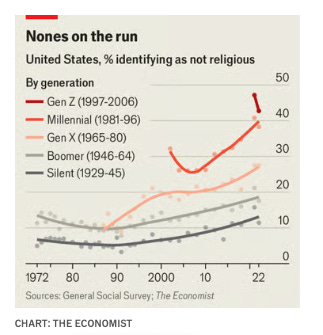
The numbers tell the story. Yes, 34% of Gen Z are religiously unaffiliated—the highest of any generation. But that means 66% aren’t. And among those who identify as religious, attendance is actually up. We’re not having a mass conversion. We’re having a mass realization that going it alone doesn’t work.
The system sold us a lie: that individualism and self-sufficiency would set us free. That we could optimize our way to happiness through productivity hacks and personal branding. That we didn’t need outdated institutions like church because we had therapy, self-help books, and wellness culture.
But you can’t therapy your way out of loneliness. You can’t self-care your way out of economic precarity. You can’t manifest your way into affordable housing.
What you can do is show up somewhere consistently, build relationships with real people, and participate in something bigger than yourself. For a growing number of Gen Z, that place happens to be church.
This isn’t really about religion. It’s about what happens when an entire generation realizes that the promises of modern life—freedom, flexibility, endless options—came with a hidden cost. We’re free to live anywhere, work remotely, date anyone within a 50-mile radius. We’re also isolated, untethered, and exhausted by choice overload.
Church offers the opposite: constraints that create meaning. Show up on Sunday. Know these people. Follow these traditions. It’s the same reason people are joining running clubs, book clubs, niche hobby communities. We’re craving structure, routine, obligation. The things our parents’ generation spent decades trying to escape.
Whether this trend lasts depends on whether churches can adapt to what Gen Z actually needs. So far, many are succeeding—less judgment, more coffee, better music, sermons that acknowledge mental health and economic anxiety. They’re meeting us where we are instead of demanding we meet them where they’ve always been.
For those of us who aren’t religious, there’s still a lesson here. We need community. We need ritual. We need to belong to something beyond our LinkedIn profiles and Instagram feeds. Find it at church, find it at a climbing gym, find it in a D&D group—just find it somewhere.
Because the alternative is what we’ve been doing: scrolling alone in our apartments, wondering why we feel so empty despite having more options than any generation in history.

Maybe my therapist was onto something. Maybe we’ve spent so long running from the constraints of organized religion that we forgot why those constraints existed in the first place. Not to control us, but to connect us.
And who knows? You might walk into a church skeptical, just looking for community and free food (the potlucks are genuinely elite). You might leave with friends, stories, and a sense of belonging you didn’t know you were missing.
Just don’t eat the apple at the church picnic. That’s how they get you.