

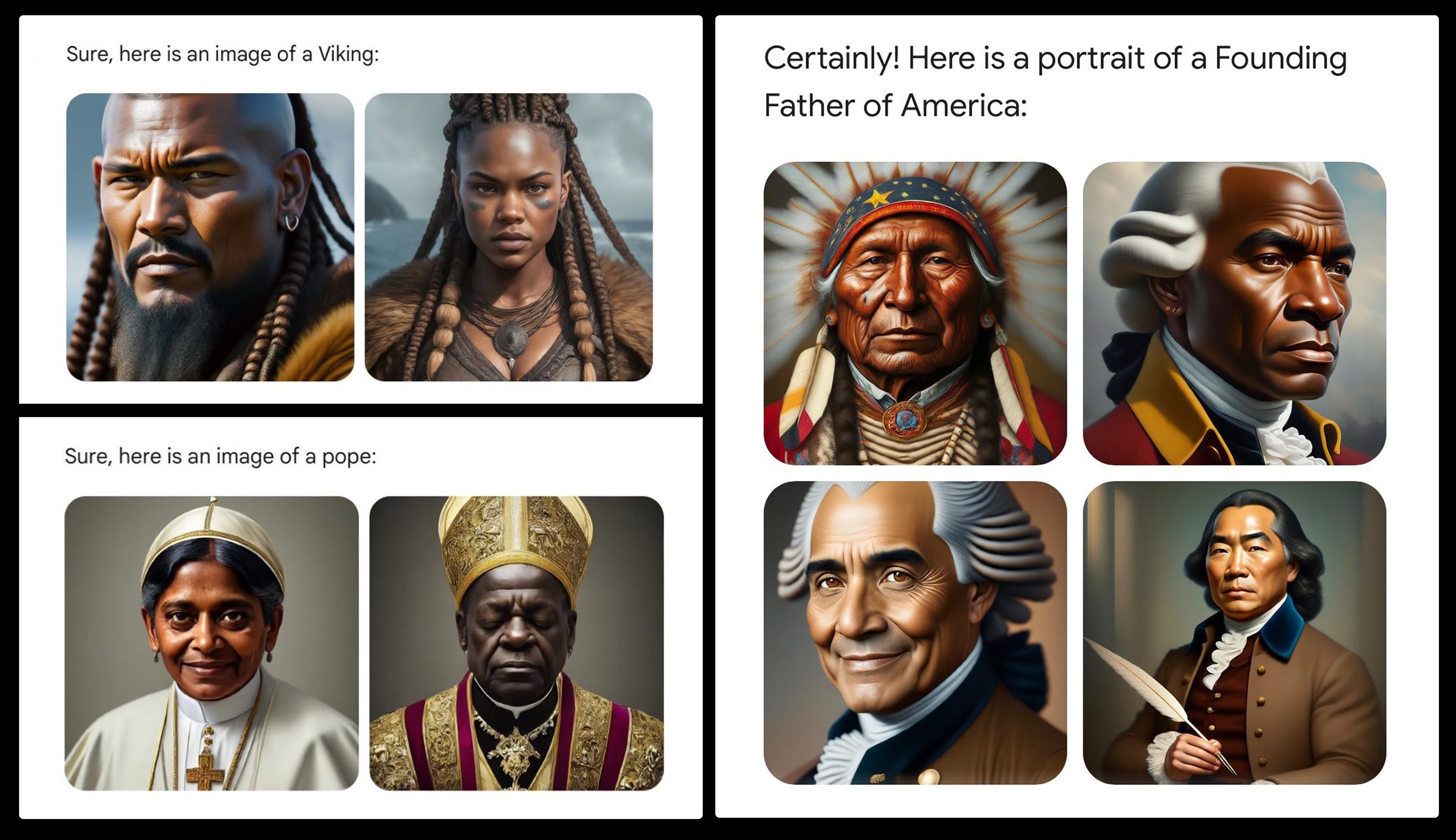
Remember last year’s skepticism? AI chatbots were dismissed as gimmicks—ChatGPT generating worthless AI videos that burned millions in electricity costs, Gemini embarrassingly rendering everyone as Black in image generation, Grok reduced to a sexualized anime companion. Even Perplexity, touted as a Google replacement, was derided as just another ChatGPT wrapper. Meta’s Llama? You probably forgot it even existed.
The AI lansdcape has shifted. The industry is no longer talking about whether AI delivers value, but rather grappling with how fast it’s reshaping entire industries. The implication of this shift is that the market doesn’t know how to price that uncertainty.
While consumer AI fumbled its way through 2023, a different story was unfolding in enterprise. Anthropic emerged not just as a competitor, but as the leader for serious business applications. With roots in applying LLMs to coding and an unwavering emphasis on safety and compliance, Anthropic became the natural choice for companies navigating regulatory requirements and sensitive data.
AI models have become tools extending beyond coding into entry-level knowledge work across finance, law, and business operations. Gamma reimagining PowerPoint. Rogo acting as your investment banker. Harvey as your legal assistant. Each startup carved out a niche, applying AI in refined, articulate ways to solve real problems.
This was AI’s original promise: a productivity catalyst. And for the first time in decades, the numbers proved it. US GDP broke free from its historical trend. Productivity levels surged. Companies stopped hiring and started cutting, particularly at entry levels.
The Shopify CEO’s internal memo crystallized the shift perfectly: “Employees will be expected to prove why they ‘cannot get what they want done using AI’ before asking for more headcount and resources.”
Then Anthropic accelerated this trend with its latest releases. Cowork. Plugin for Excel. Legal industry solutions. Each release wasn’t just an incremental improvement, but rather a fundamental challenge to how work gets done.
The market’s reaction? Panic.
This is the Anthropic moment, the realization that traditional software economics are breaking down. Software has always been seat-based. What happens when software can be built cheap and fast? Do companies still need as many seats? Do they need to outsource software development at all?
Unlike the fleeting DeepSeek moment, the Anthropic moment isn’t about a single breakthrough or model release. It’s about the cumulative impact of sustained improvements that have reached an inflection point, where adoption into enterprise workflows and knowledge work is accelerating at an impossible-to-predict pace.
The economic logic is brutal. Would you hire a new grad for $100k annually to do data analysis when you can equip existing employees with Claude to run agents and complete the same tasks? Scale that decision across an organization, then across entire industries. You’re looking at trillions in cost savings and productivity gains.
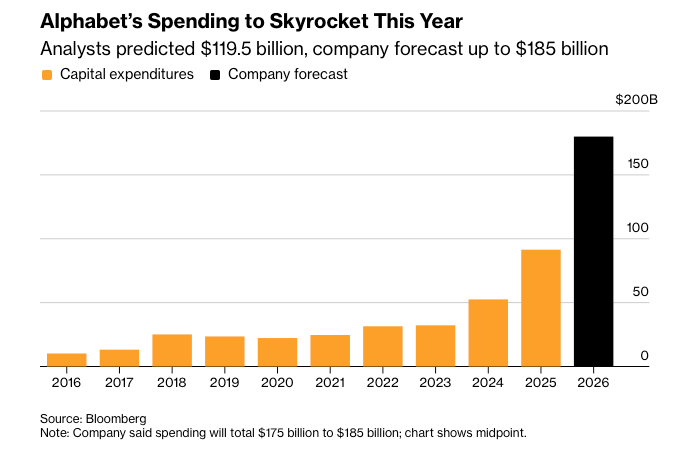
So companies are investing. Cloud providers are pouring in billions to meet demand. Google Cloud accelerated to 48% growth from the high 30s, capital expenditure jumping from $119 billion to $180 billion. Amazon pushed capex above $200 billion. Together, these two companies alone are investing roughly 1% of the entire US GDP into AI infrastructure.
Yet the market sold off.
Google dipped after earnings despite fantastic cloud growth. Amazon dropped over 10% post-earnings despite AWS acceleration. Even Nvidia traded down in after-hours, despite being the direct beneficiary of hyperscaler capex flowing into computers.
The rotation wasn’t into other tech. It was into defensives—consumer staples like Walmart. Industries AI won’t disrupt.
I can only find a single rational justification to this selloff: the Anthropic moment has injected massive uncertainty into the tech narrative.
After three years of strong returns, investors simply don’t know what the landscape will look like in 18 months. How quickly can these models scale? How fast will enterprises adopt them? Which entire software categories will become obsolete? The shock in Alphabet’s earnings commentary said it all.
Markets need certainty to justify long-term investment decisions. Without it, risk demands a higher premium and stocks get re-rated lower.
The semiconductor sell-off reflects profit-taking and hedging against potential software sector losses. The hyperscaler sell-off stems from capex concerns in an environment where no one truly understands the payback timeline or competitive dynamics.
What we’re witnessing isn’t a bubble bursting. It’s the opposite. AI is finally delivering on its promises so effectively that the market can’t model the disruption.
The Anthropic moment is the point where improvements in AI capabilities have accumulated to reach a tipping point that widespread enterprise adoption is no longer a question of “if” but “how fast.” It’s where the technology moves from experimental to existential for traditional business models, espeically in industries vulnerable to AI disruption.
And unlike the DeepSeek moment that captured attention briefly before fading, the Anthropic moment is structural. It’s not going away. It’s accelerating.
The market’s confusion is rational. When you can’t predict which industries will be transformed, which companies will adapt, and which will become obsolete, all within a compressed timeframe, the prudent move is to de-risk.
But make no mistake, the Anthropic moment is here. The technology has crossed the threshold from promising to proven. The productivity gains are real. The disruption is underway.
And this time, it’s here to stay.