

World Events — US Senate Passes Trump’s Bill
FT
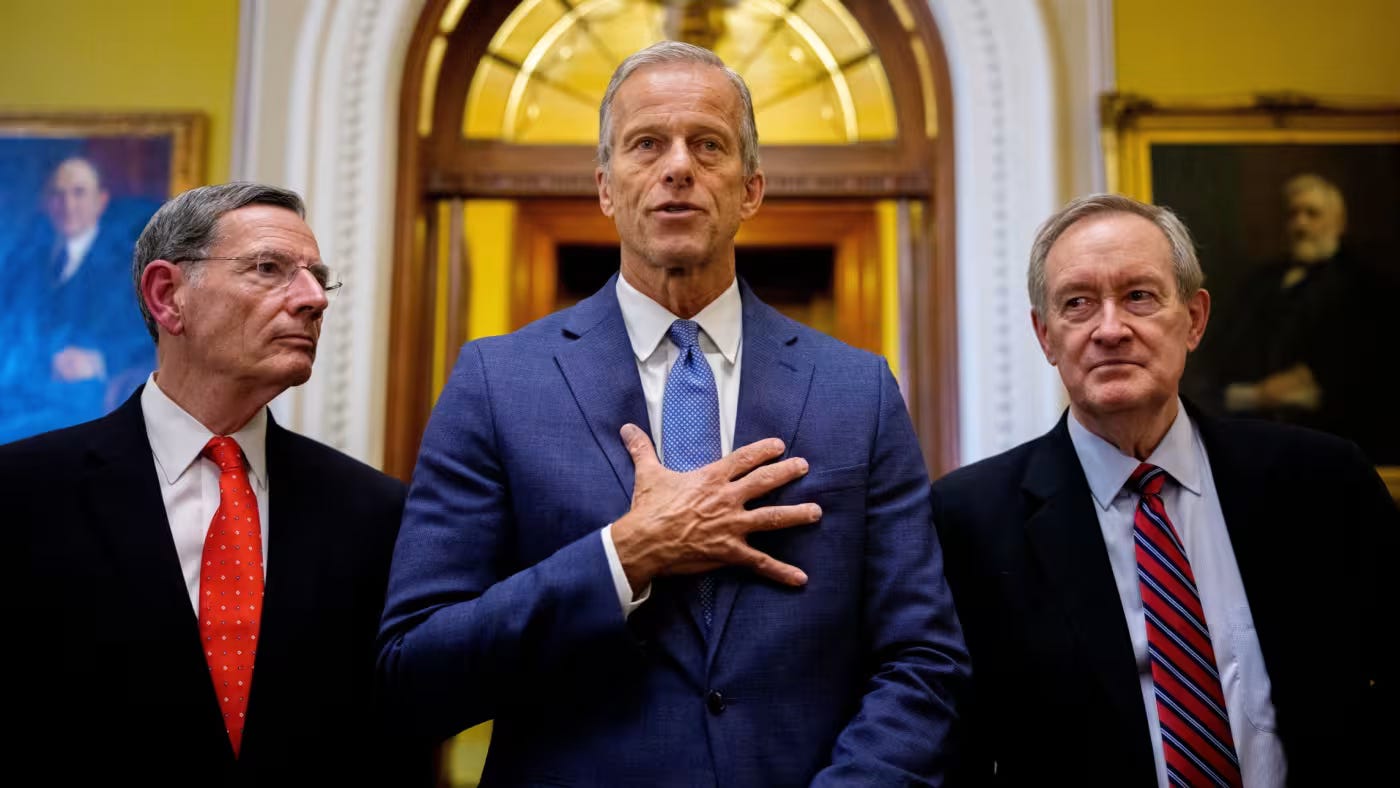
The US Senate has narrowly passed President Donald Trump’s sweeping tax and spending bill, often referred to as the “big, beautiful bill,” with Vice President JD Vance casting the decisive tie-breaking vote after a marathon session lasting over 24 hours. The legislation, which now returns to the House of Representatives for final approval, aims to extend and expand Trump’s 2017 tax cuts, introduce new tax breaks (including on tips and overtime), and increase funding for the military and border security, while offsetting some costs through deep cuts to Medicaid, food stamps (SNAP), and other social safety net programs. The Congressional Budget Office projects the Senate version will add $3.3 trillion to the national debt over the next decade—$800 billion more than the House’s earlier version—fueling criticism from both fiscal conservatives, who want deeper spending cuts, and moderates, who object to the scale of reductions in healthcare coverage for low-income Americans. Despite strong opposition from all Democrats and three Republican senators, Trump has pressed for the bill’s passage by July 4, but its fate in the closely divided House remains uncertain as GOP leaders face internal divisions over the bill’s content and fiscal impact.
Tech — Google Ended Recipe Quick View Pilot

Bloomberg
Google has ended its Recipe Quick View pilot, a feature that displayed full cooking-recipe content directly in search results, following concerns from food bloggers and creators about significant potential losses in web traffic and ad revenue. The test, which allowed users to view entire recipes—including ingredients, instructions, and images—without leaving Google Search, was framed by Google as a way to help users quickly assess recipes before visiting a site. However, many creators feared it would discourage clicks to their own websites, undermining their business models. While Google had agreements with participating bloggers and offered some compensation, it was reportedly insufficient to offset projected declines in traffic, with some estimates suggesting food blog visits could drop by half if the feature became permanent. The decision to end the pilot comes amid broader tensions between tech platforms and content creators over how online content is surfaced, used, and monetized in the era of AI-driven search.
Business — Superstar Codes are Raking It In. Others, Not So Much

Economists
A small group of elite AI engineers—those with rare expertise in developing cutting-edge machine learning models—are commanding extraordinary compensation packages, sometimes rumored to reach into the tens of millions, as tech giants like Meta, OpenAI, and top hedge funds fiercely compete for their talent. Median pay at these top AI labs can exceed $400,000 a year, while major tech companies such as Alphabet and Microsoft offer closer to $300,000, and most experienced developers elsewhere earn around $180,000. However, this surge at the top starkly contrasts with the broader market: job postings for software developers in the US have dropped by more than two-thirds since early 2022, as generative AI tools automate routine programming and companies pause hiring or cut engineering roles. The result is a widening pay and opportunity gap, with superstar AI coders in high demand and most other programmers facing stagnating prospects as businesses reassess workforce needs in the age of AI-driven productivity gains.
Culture — China Is Betting on Digital ID

Economists
On July 15, 2025, China will launch a national digital ID system for internet users, shifting online verification from private companies to direct state control—a move that marks a profound expansion of government oversight over digital life. Citizens will obtain their digital ID by submitting personal information, including facial scans, through a police-run app, and use this credential to log into websites and apps, replacing the current fragmented, company-led real-name verification system. While authorities claim the system, officially voluntary for now, will reduce data leaks and streamline access, critics warn it will further erode online anonymity, intensify censorship, and centralize surveillance power, making it easier for the state to track, monitor, and suppress dissent. The digital ID also has major economic and technological implications: by centralizing and standardizing user data, the government aims to break private tech giants’ dominance over data, facilitate data trading, and supercharge AI development with richer, more accessible datasets, potentially offsetting China’s hardware disadvantages in the global AI race. Despite official assurances about privacy and security, the move raises concerns about data breaches and the long-term erosion of digital freedoms, as opting out may become increasingly difficult as the system is normalized and incentivized across nearly all online services.
The Daily Spark
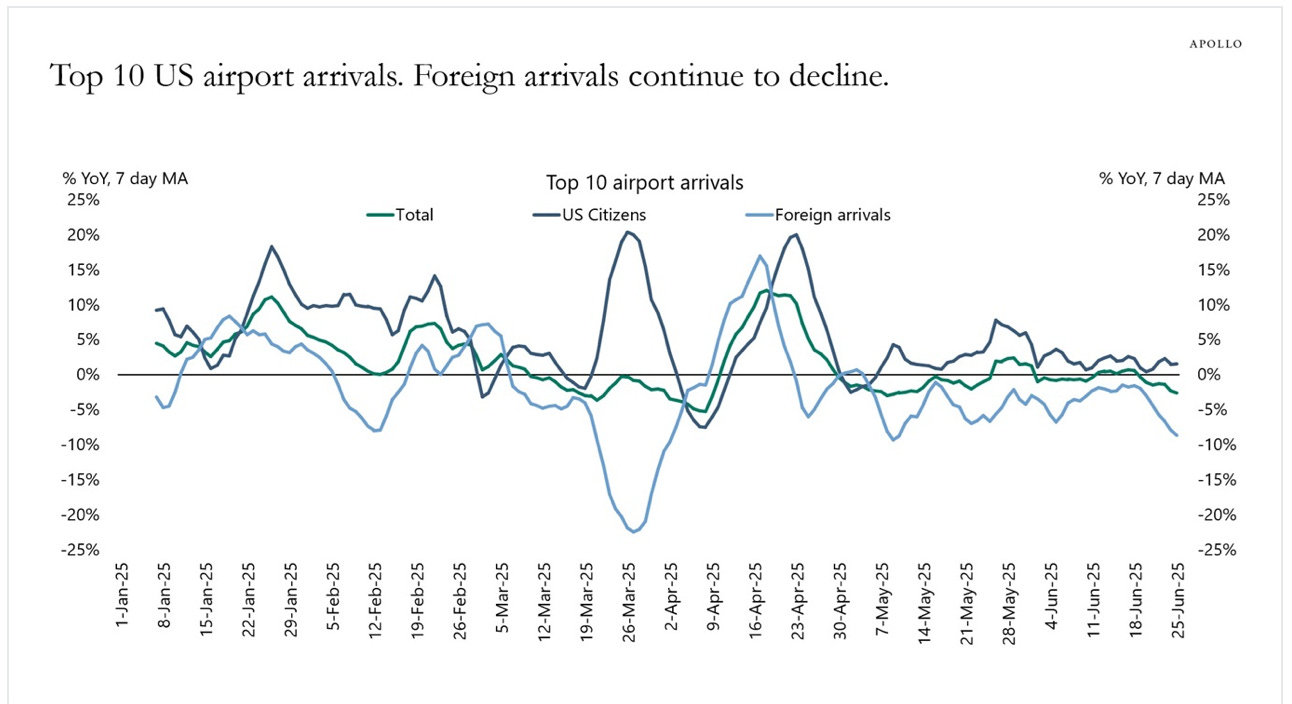
The daily data for the top 10 airports in the US shows some weakness among foreign arrivals, see the first chart below.
However, the weakness among foreign arrivals is offset by the continued strength in travel for US citizens, and the overall TSA data for the number of passengers traveling on airplanes originating in the US remains remarkably resilient, see the second chart below.
With the trade-weighted dollar down 10% since the beginning of the year, we expect to see an increase in foreign arrivals over the summer and a decline in US citizens traveling abroad.
Song Recommendation — Girls Like You
Quote of the Day
“What the wise man does in the beginning, the fool does in the end.”
― Howard Marks