


Every major technological wave triggers the same debate: is this a tool that augments human labor, or a force that displaces it? For most of industrial history, the answer has been the former. Machines made workers more productive; they rarely made workers obsolete. AI is beginning to look like an exception to that rule, and understanding why requires a clear-eyed look at what makes this wave structurally different from the ones that came before.
As investor Howard Marks observed in a recent memo, the improvements in AI have shifted from incremental to transformational, from a tool that enhances human productivity to one capable of operating fully autonomously, replacing rather than merely assisting the low- to mid-level knowledge worker. That distinction has profound implications for the labor market, for capital allocation, and for where economic value accrues across industries.
The clearest early evidence of this shift is autonomous driving. Waymo’s driverless vehicles now operate commercially across San Francisco, Los Angeles, Austin, and Washington D.C., logging millions of rider-only miles with significantly fewer injury-causing crashes per mile than human drivers. This is not an incremental safety upgrade layered on top of a human driver. There is no human driver. The economics of transportation, long built around the cost of labor, are being restructured from the ground up. But autonomous driving is a narrow domain. The broader and more consequential question is what happens when this logic of full autonomy is applied to knowledge work — to law, finance, accounting, software engineering, and analysis. To answer that, history offers a useful mirror.
Few inventions illustrate the mechanics of technological disruption as sharply as the cotton gin, patented by Eli Whitney in 1793. To understand its impact, you have to understand the bottleneck it solved. In the late eighteenth century, short-staple cotton — the variety that grows readily across the American South — was commercially worthless despite high global demand. The fibers of short-staple cotton cling tightly to their seeds, and separating them by hand was brutally slow. A single worker could clean roughly one pound of cotton per day. At that productivity rate, the economics of growing cotton in the American interior simply did not work.
Whitney’s cotton gin changed that overnight. A hand-cranked gin could process roughly 50 pounds of cleaned cotton per day, a 50-fold increase in throughput. The effect on output was staggering: U.S. cotton production exploded from roughly 1.5 million pounds in 1790 to over 35 million pounds by 1800, and to nearly 2 billion pounds by the eve of the Civil War in 1860. By the 1850s, the American South was producing roughly two-thirds of the world’s cotton supply, and cotton accounted for more than half of all U.S. export revenue. The South had not merely grown a crop, it had become the beating heart of the global textile industry. King Cotton was not a nickname; it was an economic reality.
But the cotton gin’s most instructive feature is what it did not do. It automated only one stage of the production chain, the separation of seed from fiber. It could not pick cotton from the field. That process remained entirely manual, and the explosive profitability unlocked by the gin made planters desperate to scale picking capacity as fast as possible. The result was a catastrophic expansion of slavery: the enslaved population in the South grew from approximately 700,000 in 1790 to nearly 4 million by 1860. The gin did not reduce the demand for human labor in aggregate, it concentrated and brutalized it in the one stage of production it could not touch.

Over the following century, mechanization completed what Whitney started. Mechanical cotton pickers, developed commercially in the 1940s and 1950s, could harvest as much in a day as 50 hand-pickers. By the 1970s, virtually all American cotton was machine-harvested, and what had once required an enslaved labor force of millions was reduced to a capital-intensive operation run by a handful of operators. The economics of production were fully commoditized; the value migrated upstream. Today, you can buy a plain cotton t-shirt for a few dollars. The production itself is worth almost nothing.
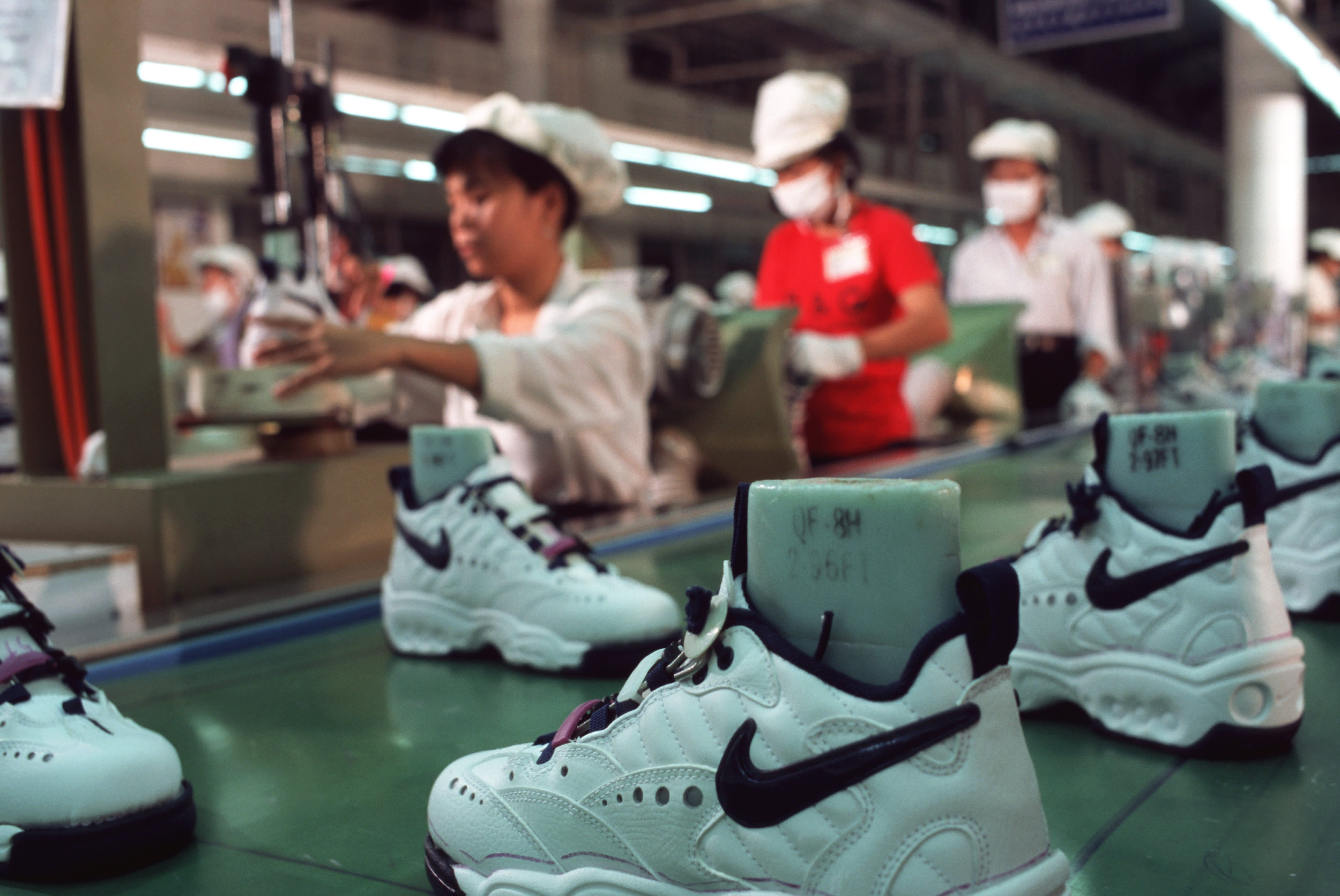
Where the value now lives is in brand, design, and the cultural meaning a company wraps around its products, in deciding what problem to solve and for whom. Nike offers the sharpest example. If you trace the supply chain, the workers stitching together sneakers in Vietnam and Indonesia are paid very little, and their wages are under constant competitive pressure from lower-cost geographies.
The company spends over $1.5 billion annually on research and design, and the vast majority of the value it captures flows from brand equity built across decades of cultural marketing. Remove the Swoosh, and you can purchase a nearly identical shoe, the growing “dupe” market does exactly this, for a fraction of the retail price. Skechers sells comparable footwear at a steep discount for the simple reason that its brand carries nowhere near the cultural weight. The production method is a commodity. The brand is the product.
This is precisely the dynamic now unfolding in knowledge work, and AI is the cotton gin at the center of it. For decades, software accelerated white-collar productivity without eliminating white-collar jobs. QuickBooks digitized bookkeeping; it did not replace the bookkeeper. Excel transformed financial modeling; it did not replace the analyst. The internet enabled legal research at unprecedented speed; it did not replace the associate reviewing documents late into the night. These were incremental gains, the human remained the bottleneck. The software was a faster gin, but someone still had to feed cotton into it.
Agentic AI removes the human from that loop entirely. An AI agent can be instructed to reconcile a full set of financial records, write and test production code, review thousands of pages of legal discovery, or clean and analyze a dataset — and it will work through these tasks continuously, without fatigue, at a marginal cost approaching zero. You no longer need a floor of junior analysts or a class of first-year associates to execute the work. You need a smaller number of experienced operators and a fleet of agents.
The economic consequence is a sharp shift in the capital-to-labor ratio across knowledge-intensive industries. The cotton gin made it profitable to deploy more land and machinery relative to skilled seed-separating labor. Agentic AI makes it profitable to deploy more compute relative to entry-level knowledge workers. The labor bill shrinks; the software bill grows; and the cost of producing the output — whether a legal brief, a financial model, or a software module — falls precipitously. The product is commoditized. And there is a critical difference from the cotton gin: Whitney’s machine automated one discrete step in one industry. AI, adaptable across domains through targeted training, can in principle be applied to any structured knowledge task. This is not a gin for cotton. It is a gin that can be reconfigured for any crop.
The commoditization of execution does not destroy value — it relocates it. As with cotton and clothing, the locus of value shifts upstream: from doing to deciding, from executing to problem-framing. The lawyer who uses an AI agent to surface relevant case law in seconds is not made redundant by that speed, but is rather freed for the judgment calls that matter: the strategic framing of an argument, the read on how a judge thinks, the client relationship that no model can replicate. The software engineer who can articulate precisely what a system needs to do, and audit the output of an agent that writes it, is worth more in a world of autonomous coding, not less. What survives commoditization is the capacity to identify the right problem, navigate ambiguity, and exercise judgment where the cost of being wrong is high. The information was never the asset. The application of information was always the asset.
A reasonable counterargument is that efficiency gains expand demand rather than reduce it, and that if AI makes each associate ten times more productive, firms will simply take on ten times more work. This is the Jevons Paradox applied to labor. When steam engines became more fuel-efficient in the 19th century, coal consumption rose because cheaper energy made more applications viable. In law, where access has long been suppressed by cost, there is a real case that AI unlocks a latent market rather than shrinks the workforce. Some categories, estate planning, small business contracts, routine compliance, almost certainly have unserved demand that cheaper AI-assisted legal services would reach.
But the optimistic scenario runs into structural limits specific to the profession. Legal demand at the high end is constrained by the number of deals and disputes in the economy, not by associate bandwidth. In this context, AI won’t generate more M&A transactions or litigation. In competitive markets, the more likely outcome is that efficiency gains compress billing rates rather than inflate headcount, as clients demand and eventually receive lower fees for work agents now do in hours.
A more fundamental concern for the industry relates to the fact that the work being automated, document review, legal research, first-draft briefs, is not just output. It is the training ground through which junior associates learn and develop the judgment that makes them valuable senior lawyers a decade later. Automate the entry level, and you hollow out the pipeline that produces the partners of the future.
All this is to say that the transition to a future dominated by AI and agents will not be smooth. The historical precedent cuts both ways. Detroit at its peak employed hundreds of thousands of workers in automobile manufacturing, anchoring a middle class across an entire region. When automation and offshoring restructured the capital-labor mix in that industry, the adjustment was not orderly. Detroit’s population fell from nearly 1.9 million in 1950 to under 700,000 today.
Flint, once a crown jewel of General Motors, never recovered. The disruption posed by agentic AI is likely to unfold faster than any of those prior waves. Automotive robotics took a generation to displace manufacturing workers, but AI is being deployed at software speed, with updates that would have required years in a hardware cycle now pushed in weeks. The displacement of entry-level knowledge workers in law, finance, and software development may compress into a window far shorter than any prior labor market transition.
The future being built by AI is not unprecedented in its broad structure. Technology has always restructured the capital-labor mix, always pushed value upstream, and always rewarded those who moved with it. What is unprecedented is the scope and the speed, and the risk is that the creation of new value and the displacement of existing workers will proceed at different speeds, and across different demographics, leaving millions of jobs displaced before any retraining infrastructure exists to absorb them. The question is whether individuals, companies, and governments can adapt quickly enough to ensure the gains are broadly shared, and that the ghost towns left behind this time are fewer than the ones left before.