

Let’s visualize a scenario.
Assume three of your male friends and three female friends are single and looking for a partner. How would you arrange their first date as a matchmaker?
The best way is to have each of them rank preferences of their potential match from #1 to #3 and pair them up based on their preferences, as you ideally want to maximize the aggregate happiness of this set up.
The Gale-Shapley algorithm examines matching as a math problem, and is a matchmaking system that pairs two groups, which in our example, are men and women looking for partners. Each person ranks their preferred partners, and the algorithm finds a “stable” matching in which the aggregate happiness is maximized when no one would be better off swapping partners with someone else. What’s surprising is that who gets to make the proposals dramatically changes the outcome.
The proposing side makes offers to their top choices. The receiving side tentatively accepts the best offer they’ve gotten so far, but can always trade up if someone better comes along. Rejected proposers move down their list and try their next choice. This continues until everyone is matched. A key insight that is derived from this process is that proposers get to “shop around” starting from their dream match, while receivers can only choose among whoever approaches them.
Let’s say three women and three men have different preferences. When women receive proposals from men, each woman can only choose from the men who approach her—she might end up with her third choice simply because her preferred partners never proposed to her. But if women were the ones proposing, each might end up with her first or second choice because she could pursue her favorites directly. In both cases the matchings are equally “stable,” but the outcome favors the side that does the proposing.
This has real-world consequences. For decades, the medical residency match used this algorithm with students proposing to hospitals, systematically giving students better placements than if hospitals had proposed. The algorithm isn’t neutral; it’s a powerful tool that favors whoever holds the right to propose, even while appearing fair on the surface.
The Gale-Shapley algorithm succeeds in matching medical residents to hospitals and students to schools because it operates under crucial constraints that modern dating fundamentally violates. In functional matching markets, participants face limited capacity, forced commitment, and bounded choice sets. These constraints force realistic preference formation and eventual acceptance of good matches.
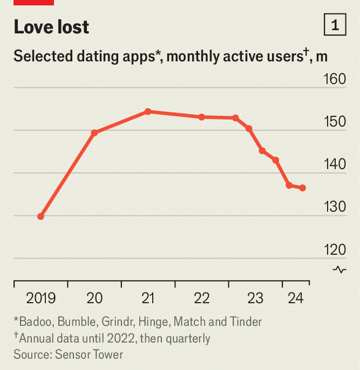
Modern dating, as evident with online dating, creates an illusion of unlimited options where users can perpetually swipe through thousands of profiles, top-tier individuals face no capacity constraints forcing them to commit, and no mechanism exists to bind matches into actual relationships. The algorithm assumes people will eventually accept their best available match, but dating apps allow, and profit from, users rejecting viable matches indefinitely while chasing unrealistic ideals.
This dynamic creates the “abundance mindset paradox.” Before modern dating, geographic and social constraints naturally created small, bounded pools of potential partners, perhaps 50-200 people you’d realistically meet through work, school, or social circles. Within these limited pools, people naturally calibrated their expectations through feedback and social proof, learning their approximate “market position” and accepting good matches accordingly.
Online dating and social media together destroyed these natural constraints by providing complete market information. Users can now see profiles of tens of thousands of potential partners on dating apps while simultaneously being exposed to carefully curated highlight reels of the most attractive and accomplished people on Instagram, TikTok, LinkedIn, and other platforms. Dating apps show you the top 1% of potential partners in your area, while social media shows you the top 0.01% of attractive people globally, creating a double layer of unrealistic benchmarking.
This constant exposure fundamentally warps preference formation. A person who might happily date someone in the 60th percentile of their local pool now compares them not just to the 90th percentile on dating apps, but to the algorithmically-curated “perfect” bodies and lifestyles flooding their social media feeds. The result is rejection of realistic local options while pursuing dating app matches in the top tier—who themselves are chasing even higher, influenced by the same social media exposure—and who, drowning in options and comparing their matches to Instagram ideals, never commit to anyone. Social media doesn’t just show you better options, it manufactures an entirely fictional standard of what you “deserve” based on people whose attractiveness, wealth, and lifestyle are often professionally produced, filtered, and completely unattainable for 99.9% of the population.
This exposure calcifies into rigid, non-negotiable requirements that further break the matching mechanism: the person must be over 6 feet tall (eliminating 85% of men), earn over $100,000 annually (eliminating 90% of people), and have model-level looks (eliminating 99%). These fixed parameters, often targeting characteristics that describe less than 1% of the population, aren’t presented as preferences but as minimum standards, below which a person is considered “settling.”
The cruel irony is that being realistic about partner selection has become culturally conflated with choosing a subpar partner, when in reality it’s simply acknowledging market constraints. Just because you’re a straight-A student doesn’t mean you automatically get into Harvard; you might end up at UC Berkeley, an excellent school, simply because so many qualified students are competing for limited Harvard spots.
This isn’t to say you should settle for a community college if you’re a genuinely brilliant student, as the Gale-Shapley algorithm is designed to get you the best match you can realistically attain, not to force you into an incompatible pairing. The point is recognizing that UC Berkeley, while not Harvard, is still an outstanding institution where you can thrive, just as a partner in your realistic range, say, the 60th-80th percentile if you’re in the 70th, can be genuinely wonderful, even if they’re not the Instagram-perfect ideal.
The quality of both education and relationship depends far more on what you make of it than the brand name or superficial metrics. A partner who is 5’10”, earns $75,000, and is genuinely kind and compatible might create a far better relationship than the 6’2” high-earner you’re endlessly pursuingm, but you’ll never discover this if you filter them out entirely based on height and income requirements derived from social media fantasies.
The equivalent of refusing to attend any university because you didn’t get into Harvard is precisely what’s happening in modern dating. People are choosing to remain unmatched indefinitely rather than “settle” for partners who don’t meet arbitrary ideal standards and never realizing that the ideal itself is a statistical impossibility and that fulfilling relationships.
Viewing the ideal as the realistic discounts what matters most in a relationship—finding a partner whose values align with yours, who is supportive and honest, who pushes you and challenges you to grow together, and who accepts you at your best and your worst.
As Shakespeare wrote in Sonnet 116:
Let me not to the marriage of true minds
Admit impediments; love is not love
Which alters when it alteration finds,
Or bends with the remover to remove.
O no, it is an ever-fixèd mark
That looks on tempests and is never shaken;
It is the star to every wand’ring bark
Whose worth’s unknown, although his height be taken.
Love’s not time’s fool, though rosy lips and cheeks
Within his bending sickle’s compass come.
Love alters not with his brief hours and weeks,
But bears it out even to the edge of doom:
If this be error and upon me proved,
I never writ, nor no man ever loved.
Shakespeare understood four centuries ago what matching theory proves today—that true worth cannot be measured by superficial characteristics we use to filter partners. The algorithms that work succeed because they prioritize compatibility and stability over the endless pursuit of an unattainable ideal. The best match isn’t the one that looks perfect on paper, but the one that proves steadfast “even to the edge of doom.”
SO SO GOOD! Always brings be pack to paradox of choice and of settling for “good enough” which IS also good, not Harvard but UC Berkeley