

World News — Trump and Carney Talks About Trade
Bloomberg
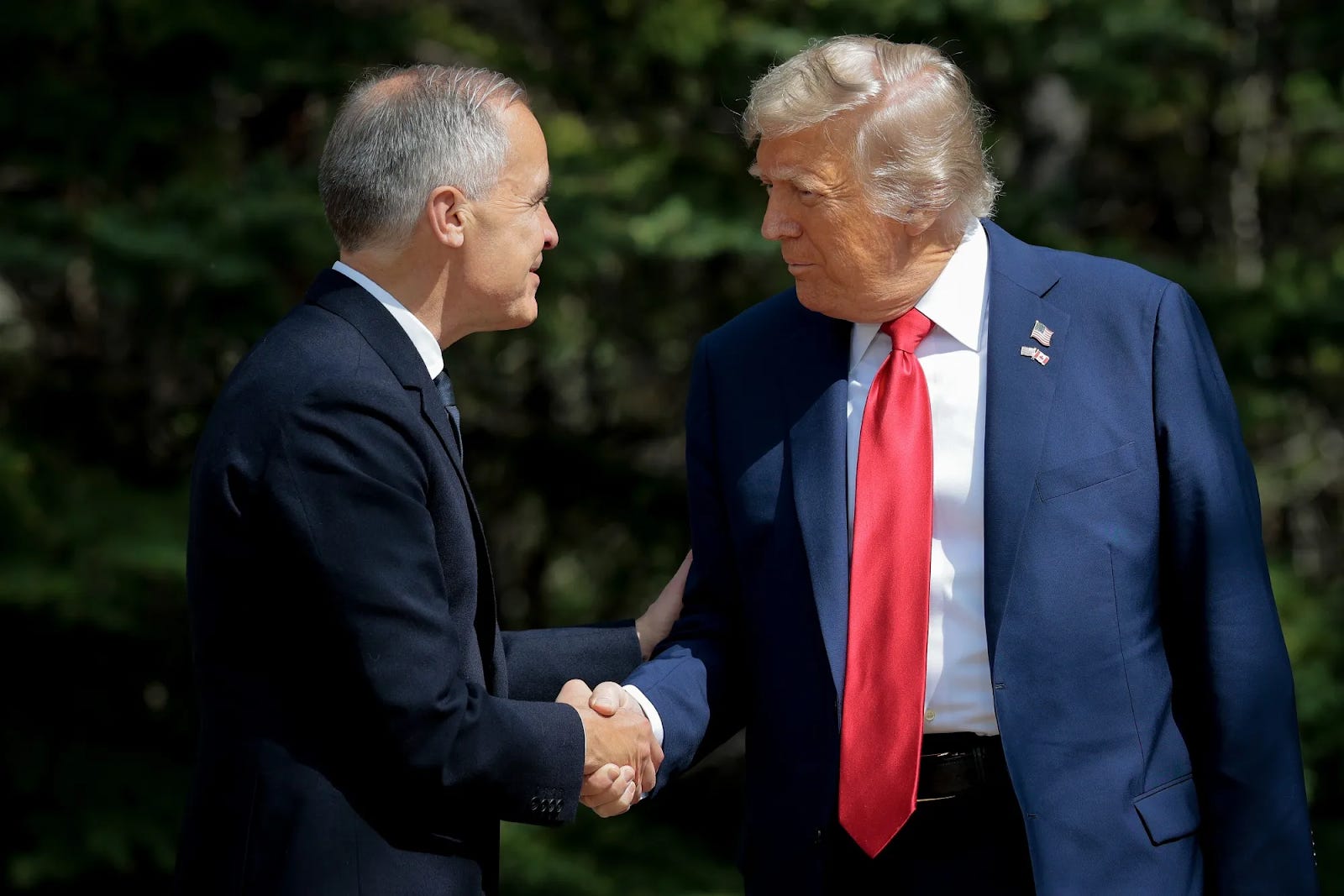
U.S. President Donald Trump and Canadian Prime Minister Mark Carney held a wide-ranging call Thursday covering trade tensions and the war in Ukraine, the first publicly acknowledged discussion between the two leaders since Trump imposed a baseline 35% tariff on Canadian goods earlier this month. Carney initiated the conversation, which focused on shared economic and security priorities, opportunities in the bilateral trade relationship, and supporting long-term peace in Ukraine and Europe. Both sides confirmed the exchange, though the Trump administration provided fewer details, and agreed to speak again soon. The tariff hike has hit Canada’s steel, aluminum, and auto sectors particularly hard, prompting Carney to accelerate trade diversification efforts, including an upcoming trip to Mexico, while his ministers pursue defense and industrial partnerships in Scandinavia.
Tech — The Fantasy of Home-grown Chips

Economists
Donald Trump’s push for “home-grown” U.S. semiconductor production reflects a protectionist vision that clashes with the deeply globalized and specialized nature of the chip industry, where America’s success depends on allies and supply chains spanning Taiwan, Japan, South Korea, and beyond. Intel’s decline illustrates the pitfalls of pouring subsidies into a floundering firm: despite billions in promised support, it remains far behind Taiwan’s TSMC and South Korea’s Samsung in cutting-edge chipmaking, and even with massive new investment, its prospects are uncertain. Trump’s threats of tariffs and pressure on firms like Nvidia to rely on Intel may buy time but risk weakening U.S. competitiveness by forcing reliance on inferior technology. A stronger strategy, experts argue, lies not in autarky but in making America attractive for foreign fabs through streamlined permits, skilled workforce training, and cooperation with like-minded allies, ensuring resilient supply chains while reinforcing—not isolating from—America’s global partners.
Business — Walmart Reports the Impact of Tariff
Walmart warned that U.S. President Donald Trump’s tariffs are steadily raising its costs, squeezing profits even as more shoppers turn to the retailer for affordable goods. With roughly a third of its U.S. merchandise imported from countries like China, Mexico, Vietnam, and India, Walmart has been stocking up ahead of the holiday season but says its inventory is now being replenished at post-tariff prices, driving weekly cost increases that will continue into year-end. CEO Doug McMillon noted that while customer behavior changes remain muted, middle- and lower-income households are feeling the strain most, cutting back on discretionary items. Walmart lifted its annual sales forecast after U.S. same-store sales rose 4.6% and global revenues reached $177.4 billion in the second quarter, but operating profit fell 8.2%, disappointing investors as shares dropped 4.5%. The warning comes as markets await Federal Reserve Chair Jay Powell’s Jackson Hole speech, with inflation risks from tariffs a central focus.
Culture — Facekini

Economists
China’s latest fashion craze, the “facekini,” has surged from a niche beach accessory for older women into a mainstream, youth-driven trend, with sales of sun-protection masks jumping 50% in the past year as part of an $11bn UV-wear industry. Once seen as unfashionable, facekinis—made of washable synthetic fabric and costing from a few dollars to $50—are now marketed as stylish skincare tools that complement office and outdoor attire, reflecting growing demand for products that help maintain fair complexions. Companies like Beneunder, along with major sportswear brands such as Anta and Li-Ning, are profiting from the boom, even as China’s Communist Party voices unease, warning of a manufactured “sun-protection anxiety.” Fashionable or fleeting, the facekini has transformed from beachwear oddity to national fad.
The Daily Spark
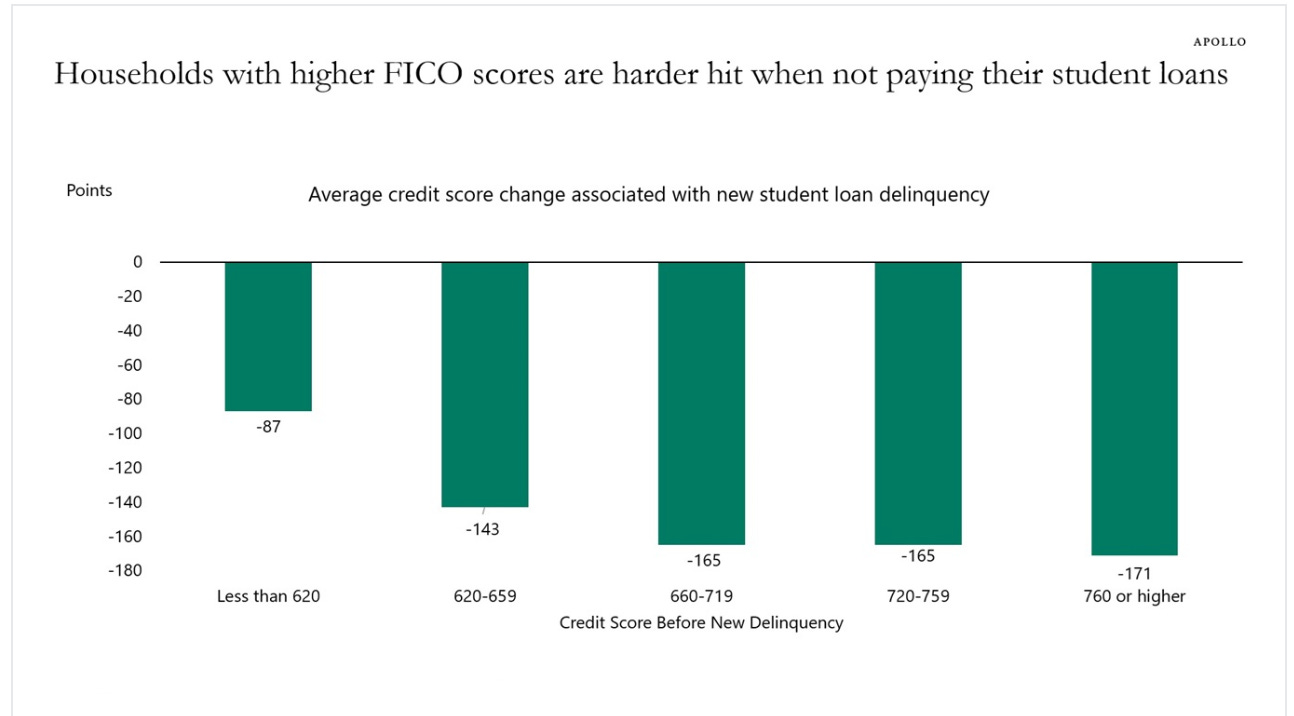
When households stop paying their student loans, their credit scores will go down. The chart below shows that for households with a FICO score higher than 760, the average credit score change associated with a new student loan delinquency is a decline of 171 points.
Forty-five million people have a student loan, and about 11 million, or 25%, are either in default or more than 90 days delinquent.
The bottom line is that the US consumer is facing headwinds from student loan payments restarting.
Binge Rec — WSJ on Crocs
Quote of the Day
“The difficulty lies not so much in developing new ideas as in escaping from old ones. Words ought to be a little wild for they are the assault of thoughts on the unthinking.” - John Maynard Keynes