

Morning!
What if the world we live in is just utter chaos? We’re watching Wall Street panic over a language app choosing long-term vision over quarterly profits, tech giants scrambling to break one company’s chokehold on AI’s future, global powers repeating the same failed playbook in the Middle East, and our generation inheriting skyrocketing cancer rates from decades of modernization we had no control over. The common thread? The world we’re living in is changing constantly, full of chaos, but we’re finding ways to resist and adapt anyway.
The Markets - The Owl That Made Wall Street Lose Its Streak
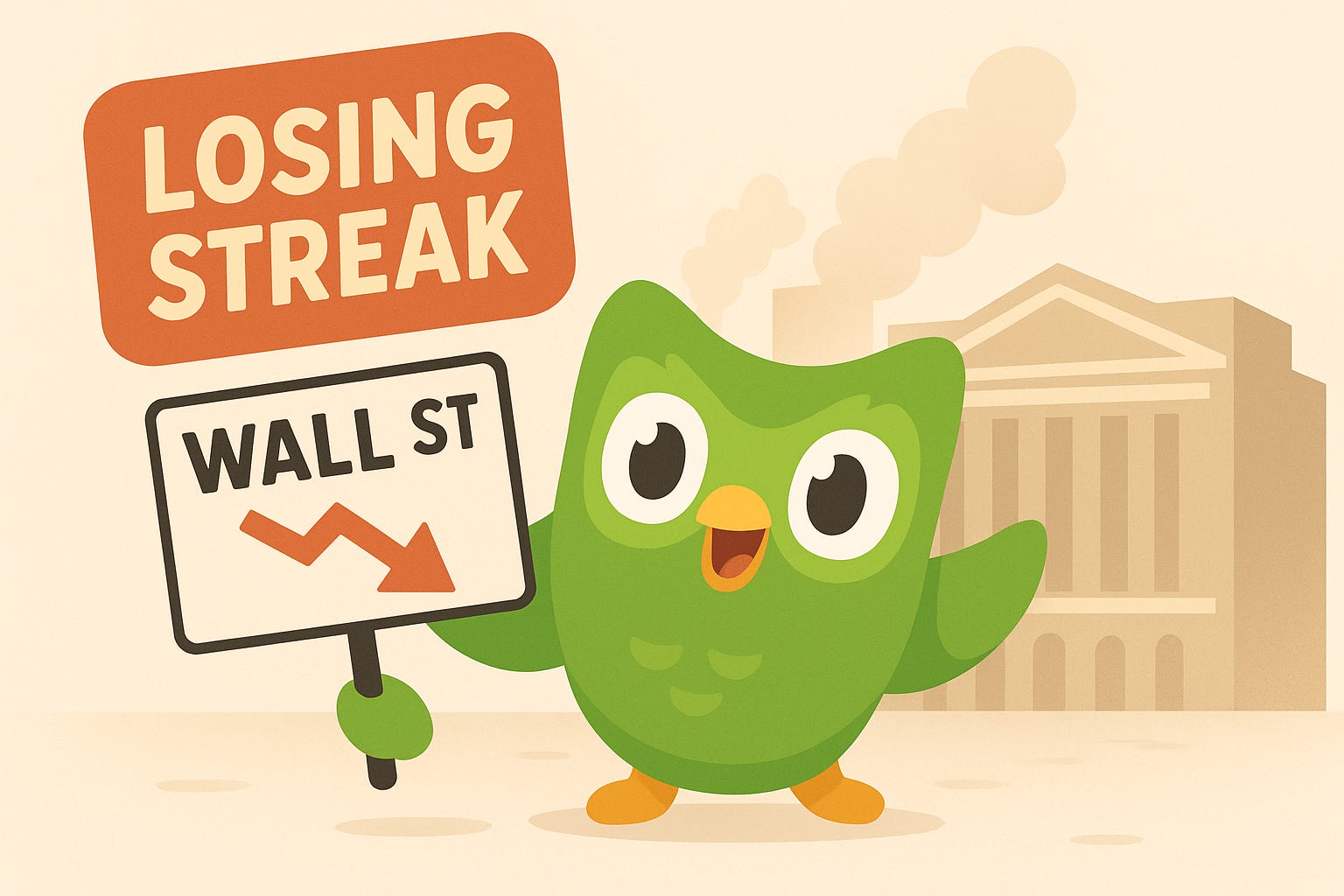
Picture this: you’re at a club, bass thumping, lights flashing, and your friend suddenly stops mid-dance to whip out their phone—not to take a selfie, but to complete their Duolingo streak. Or maybe you’re scrolling Instagram and get hit with another thirst trap of the handsome Duolingo man that has your group chat absolutely losing it. This is the grip Duolingo has on our generation, a generation desperate to learn new languages, pack our bags, see the world, and collect memories that actually matter. The app cracked the code on making learning feel less like a chore and more like a game you’re genuinely addicted to. No other platform even comes close to that dopamine hit of keeping your streak alive or seeing that green owl cheer you on.
And the numbers reflected that magic. Their premium Max tier absolutely exploded, doubling in bookings year-over-year, with users happily shelling out $30 a month to practice language skills with AI characters instead of fumbling through awkward conversations with real humans. Average revenue per subscriber climbed 7%. Everything seemed to be vibing perfectly.
Then came the gut punch: the stock cratered 20% in after-hours trading. Wall Street took one look at Duolingo’s fourth-quarter bookings guidance—$329.5 million to $335.5 million versus the expected $344.1 million—and hit the panic button. The question burning in everyone’s mind: Did Duolingo lose its sauce? Did they stop posting those iconic thirst traps? Are we witnessing the slow death of the green owl empire?
Here’s what Wall Street completely missed. CEO Luis von Ahn isn’t trying to milk the cash cow dry; he’s trying to build an entire farm. The founder-led team sees a massive opportunity where AI can transform learning far beyond just languages. Math, music, chess, and honestly, they should add cooking because Gen Z legitimately cannot cook and we might actually be cooked on that front. Von Ahn made a calculated bet to sacrifice some short-term profits to capture a vastly bigger slice of the learning market. They could’ve easily squeezed every dollar out of language learners right now, but instead they’re playing the long game, expanding the pie rather than just dividing it up.
We’ve watched this movie before—Dell in 2013, taking itself private in what Forbes called the “deal of the century,” escaping the suffocating pressure of quarterly earnings calls to orchestrate one of the most spectacular corporate comebacks in tech history. Duolingo has that same founder-led DNA, that same refusal to compromise vision for Wall Street’s impatience. Yes, the bookings miss stung. Yes, investors dumped shares in a knee-jerk panic. But the company still raised its full-year revenue growth guidance to 38%, crushing Wall Street’s 36% estimate.
The answer? This isn’t a company in decline. It’s a company choosing transformation over safe bets, innovation over instant gratification. These are the growing pains of something bigger taking shape, and honestly, that’s exactly the kind of ambitious swing I want to see from a platform that’s already revolutionized how millions of people learn. The green owl isn’t just teaching us languages anymore—it’s teaching Wall Street a lesson that good things take time.
Health - We Can’t Afford Therapy or Cancer, So We’re Joining Run Clubs

Here’s the unsettling reality hitting Millennials and Gen X hard: early-onset cancers—diagnosed in adults between 18 and 49—are skyrocketing, with younger generations showing increased incidence in 17 of 34 cancer types, including breast, colorectal, and pancreatic cancers. This isn’t random bad luck—it’s the bill coming due for decades of modernization that transformed how we live. The generations before us saw massive urbanization, the explosion of office work trapping people in chairs for 8+ hours daily, and the rise of sugary drinks like Coke becoming a cultural staple, processed foods dominating grocery stores, and sedentary lifestyles becoming the norm. These early-onset cancers tend to be brutal too—younger women are more likely to develop aggressive triple-negative breast cancer, and colorectal cancer has become the leading cause of cancer death in men under 50, often catching people before they even hit the recommended screening ages of 40 for mammograms and 45 for colonoscopies.
And honestly? We as Gen Z are inheriting an even grimmer situation. We grew up with phones glued to our hands, scrolling through anxiety-inducing content that’s made us statistically more depressed and anxious than any generation before us. We go outside less, socialize in person less, and struggle with poor diets that have fueled a rise in eating disorders, early hair loss, and other health issues that previous generations didn’t face until much later.
The physical and mental toll is real. Yale Medicine specialists note that genetic mutations like BRCA only account for 20% of early-onset breast cancers, meaning environmental and lifestyle factors are driving the majority of cases, and we don’t even fully understand why yet. Beyond the physical battle, younger patients face fertility concerns from treatments, potential early menopause, body image struggles, and the psychological weight of decades ahead wondering if the cancer will come back.
But we’re not accepting this fate, fighting back with a health consciousness that’s become almost defiant. We’re flocking to Sweetgreen instead of fast food, obsessing over protein bars and smoothie bowls, joining run clubs that double as social therapy, hitting pilates classes, and turning wellness into a lifestyle movement that our parents’ generation never prioritized at our age. We’re talking openly about mental health, advocating for ourselves in doctors’ offices (because you absolutely should push back if a doctor dismisses your symptoms as “just hemorrhoids”), and sharing family health histories to get earlier screenings (if a first-degree relative had cancer at 45, you should start screening at 30).
The bottom line that you should stay vigilant about your health. Don’t ignore unusual symptoms. Try to eat clean, exercise religiously, never smoke. Love yourself enough to prioritize preventive care, because our generation deserves to live long, healthy lives despite inheriting a world that didn’t always set us up for success.
World News - From 36% to 8%: How Gaza Changed Everything for Young Americans

Israel conducted extensive air strikes on southern Lebanon Thursday, targeting what it claims are Hizbollah positions attempting to rebuild capabilities, despite a US-brokered ceasefire agreed last November that was meant to end hostilities between the two sides. The strikes are part of an intensifying pattern of near-daily Israeli attacks that have continued since the truce, raising fears of renewed escalation and killing hundreds of people including over 100 civilians, while Hizbollah maintains it remains committed to the ceasefire but retains the right to resist what it calls Israeli occupation.
Breaking Down the Foreign Affairs For You
Here’s the brutal reality: the Middle East crisis has been grinding on for far too long, with the Gaza War kicking off over two years ago. Yet somehow, despite all the bloodshed and destruction, we’re right back where we started—stuck in the same exhausting cycle of tit-for-tat exchanges in the region. While the Gaza War showcased Israel’s military capabilities, it’s created cascading complications that are impossible to ignore. Israel remains heavily dependent on US military support, but since Gaza, political backing has seriously eroded across the West—Europe has grown increasingly critical, Canada formally recognized Palestinian statehood, and within the United States itself, widespread student protests erupted on campuses, directly challenging continued American support in ways we haven’t seen since the Iraq War.
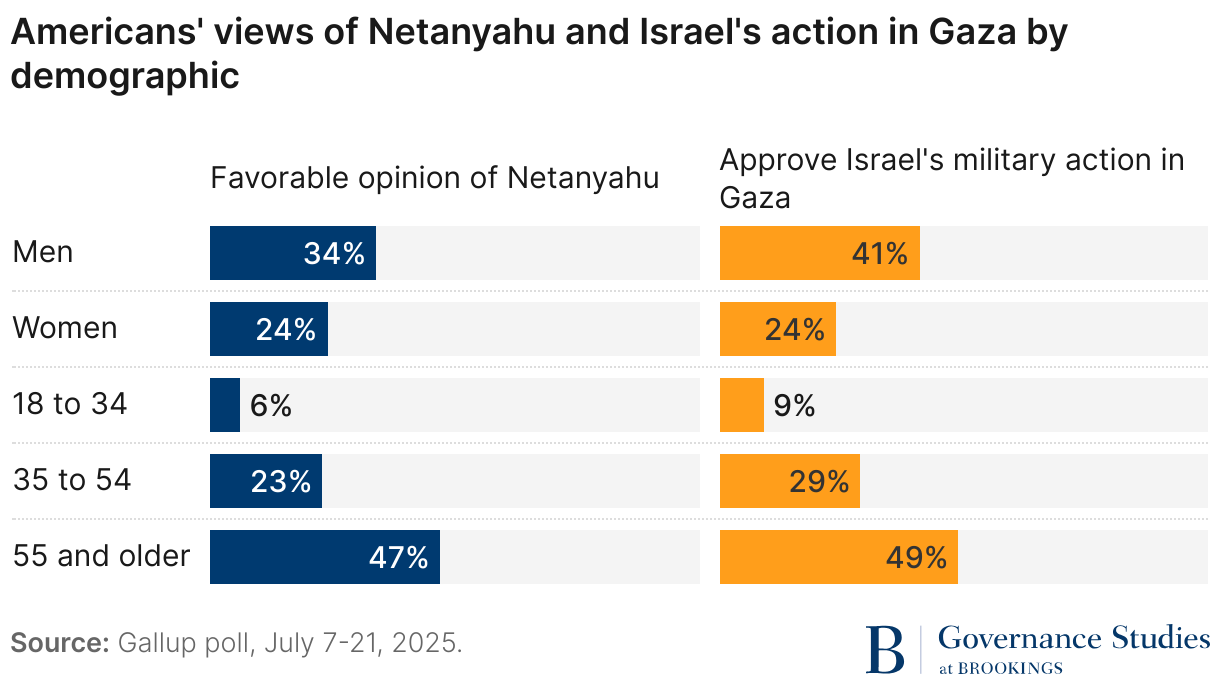
The numbers paint a devastating picture: among U.S. adults, negative views of Israel have skyrocketed from 42% to 53% since 2022, and among Democrats specifically, support has crashed from 36% at the war’s start to a shocking 8% today. We’re scrolling through devastation on TikTok, watching entire neighborhoods reduced to rubble on Instagram Stories, seeing the human cost in ways previous generations never could. This generational shift means United States’s unconditional support for Israel is no longer a political given. Continuing down a path that prioritizes military coercion over genuine diplomatic engagement won’t achieve lasting peace in the Middle East; it’s literally planting seeds for the next cycle of conflict, guaranteeing prolonged instability for another generation. The question isn’t whether change is coming—it’s whether leaders will adapt before the next explosion, or whether we’re doomed to watch this tragic loop play out again and again.
Tech Rapid Fire: The Great AI Chip Chase: Google’s Ironwood Makes Its Move
Google is launching its seventh-generation Tensor Processing Unit (TPU) called Ironwood for public use, marking a significant move in the fierce competition among tech giants to dominate AI infrastructure. The in-house chip, which is over four times faster than its predecessor and can connect up to 9,216 units in a single pod, aims to challenge Nvidia’s dominance by offering custom silicon with advantages in price, performance, and efficiency. Major customers like Anthropic have already committed to using up to 1 million of the new TPUs, and the launch comes as Google reported 34% cloud revenue growth to $15.15 billion last quarter while raising its capital spending forecast to $93 billion to meet surging AI infrastructure demand.
Chart of the Day
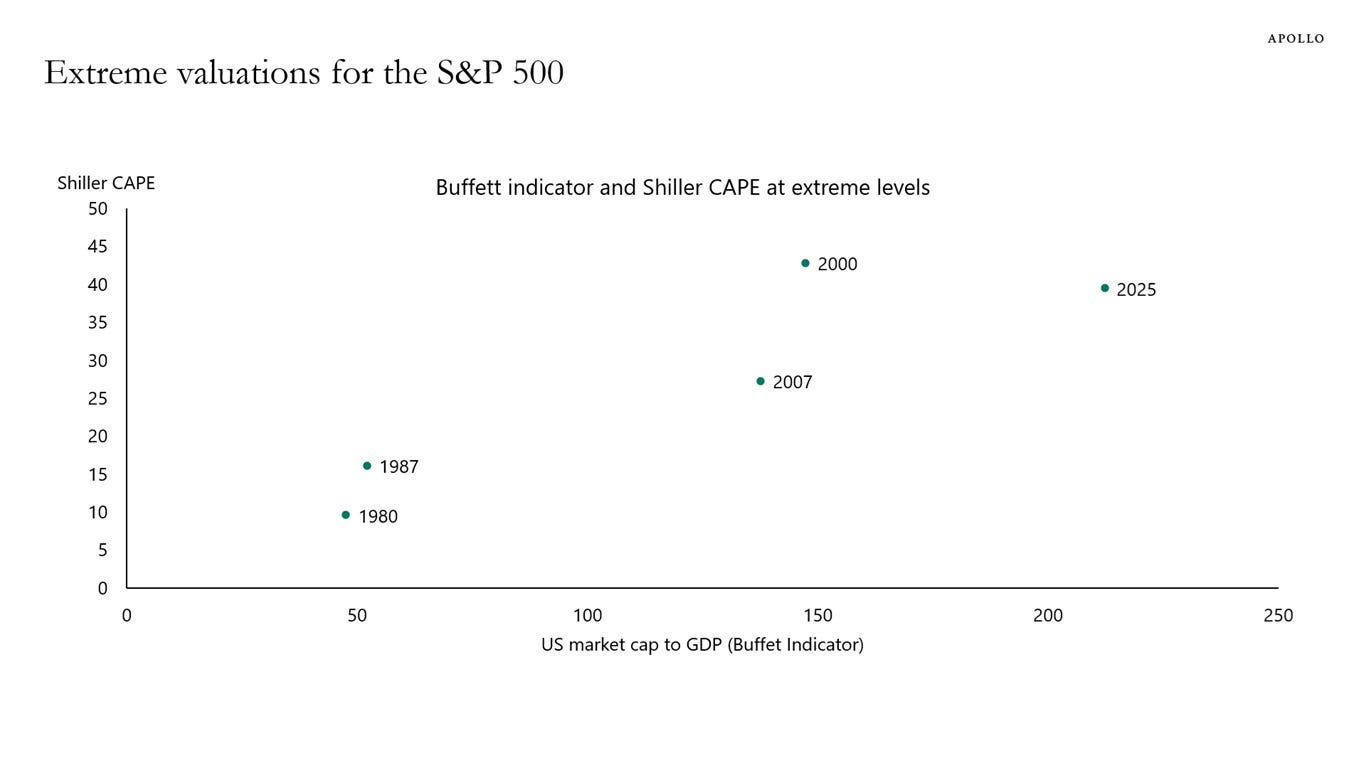
A bubble?
Song Recommendation - Apollo 18
Quote of the Day
“Irrational exuberance is the psychological basis of a speculative bubble. I define a speculative bubble as a situation in which news of price increases spurs investor enthusiasm, which spreads by psychological contagion from person to person, in the process amplifying stories that might justify the price increases and bringing in a larger and larger class of investors, who, despite doubts about the real value of an investment, are drawn to it partly through envy of others’ successes and partly through a gambler’s excitement.”
― Robert J. Shiller, Irrational Exuberance