

Picture this: You just dropped $2 million on a stunning Vancouver home in Point Grey. Ocean views. Perfect neighborhood. Life is good. Then you wake up the next morning and geologists are on TV saying there’s now a 50% chance of a magnitude 8 earthquake in the next decade.
Would you have still bought it? Hell no. Unless you’re already planning your funeral, you’re demanding your money back or a massive discount. Because the game just changed overnight.
Now replace “Vancouver home” with “software company stocks” and “earthquake” with “AI.” Congratulations, you’re a Wall Street investor in February 2026. And you’re absolutely panicking.
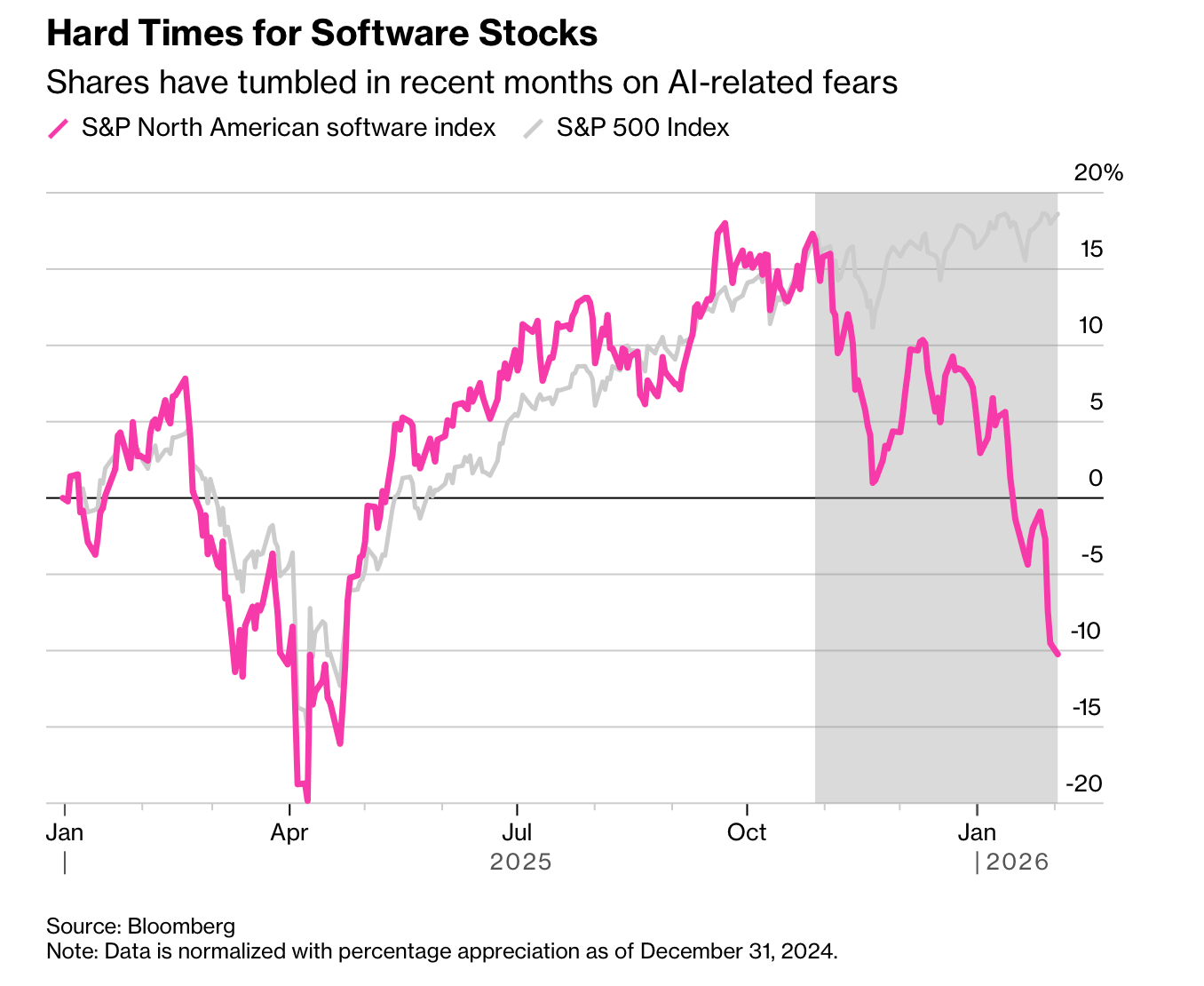
On Tuesday, February 3rd, $285 billion evaporated. Gone. In one day. Thomson Reuters down 16%. Legalzoom down 20%. The software index posted its worst day since October 2008, a 15% nosedive.
And what caused this carnage? A blog post.
Anthropic, the company behind Claude AI, quietly released a tool that automates legal work. Just dropped it on their website. No fanfare. No press conference. Before the opening bell even rang, traders were hitting the sell button like it was on fire. The panic wasn’t about one legal tool. It was the sudden, visceral realization: “Oh shit, if AI can do this to lawyers, nobody’s safe.”
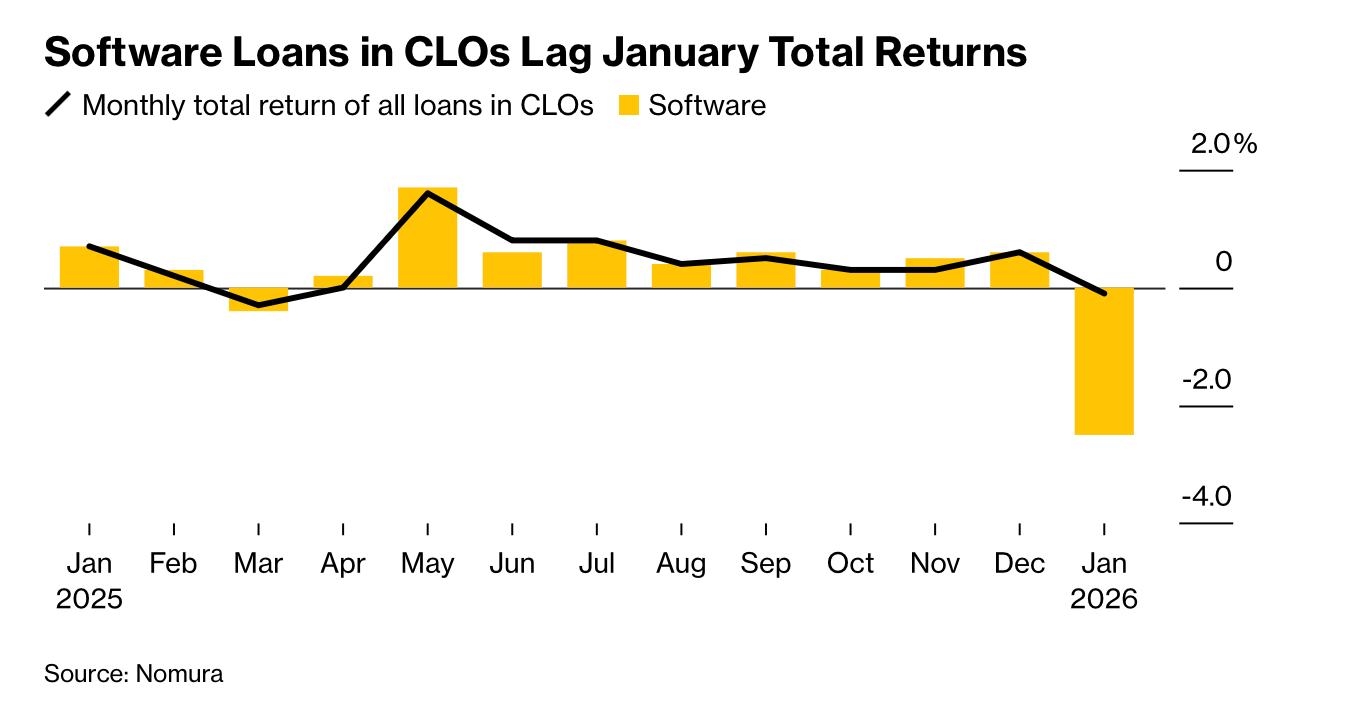
The bloodbath spread faster than wildfire. Software loans collapsed. Private equity titans who’d been gorging on software deals at absurd valuations got destroyed. Blue Owl Capital, which basically built its empire betting on software, crashed 13% to a nine-day losing streak record. Ares, KKR, TPG? All down 10%+. These are firms managing trillions. And they’re getting absolutely wrecked.
Software represents 12% of the entire leveraged loan market. That’s not a niche corner. That’s the foundation. And it’s cracking. UBS analysts are now estimating default rates could hit 13%. To put that in perspective, that’s nearly triple the normal rate. Banks are quietly freaking out.
Now, the defenders will tell you everyone’s overreacting. The Economist literally made fun of the panic, pointing out that even OpenAI uses Slack (owned by Salesforce). Jensen Huang from Nvidia called it “exaggerated,” insisting AI turbocharges software rather than destroys it.
Cool story. Except the market doesn’t care about your hot takes. The market cares about numbers. And the numbers are brutal.
This quarter, only 67% of software companies beat revenue expectations versus 83% for tech overall. Microsoft reported decent earnings and still dropped 10% in a day because cloud growth is slowing. January was its worst month in over a decade. SAP mentioned “slight deceleration” and fell 15%. ServiceNow beat estimates and still dropped 13%.
These aren’t startups burning through venture capital. These are the giants. The “indispensable” ones. Adobe for creatives. Workday for HR. Salesforce for literally everything. If you work at a company, you’re probably using their software right now.
But here’s the thing about “indispensable”—that’s exactly what everyone said about IBM 50 years ago. IBM owned mainframes like Apple owns iPhones. Suggesting IBM wouldn’t be the world’s most valuable company would’ve gotten you laughed out of every boardroom in America.
Then personal computers happened. Then the internet. Then smartphones. Each wave brought entirely new winners: Dell, Microsoft, Apple. IBM? Still around. Still making money. But completely irrelevant compared to what it was. A shadow. A reminder that dominance is temporary when the technology shifts.
That’s what keeps investors up at night. Not that Salesforce disappears tomorrow. But that AI represents a fundamental shift, a new game where all the walls the incumbents built over decades become meaningless. Where startups can simply go around them, like how the Germans bypassed the Maginot Line that the French built after World War I by going through Belgium.
And one company is already proving this thesis works: Palantir just reported 70% revenue growth and guided for 61% next year. Seventy. Percent. Meanwhile, where’s Salesforce’s acceleration? They’ve been hyping their AI agent “Agentforce” for a year. Where’s their explosive growth?
Crickets.
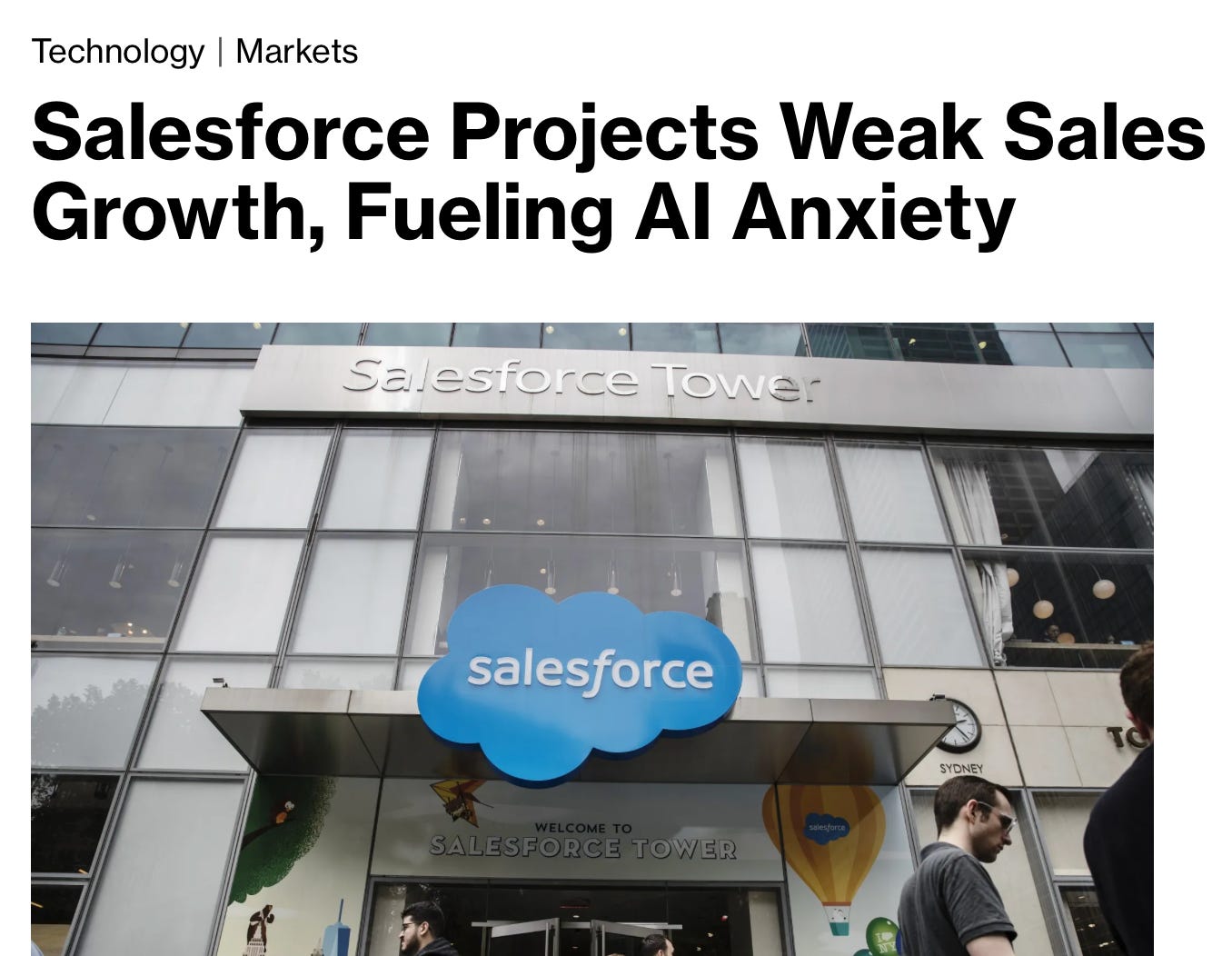
That’s why the market is dumping these stocks. Not because of irrational fear. Because these companies trade at premium valuations as growth stocks, keep promising AI will save them, and then... nothing. No acceleration. No proof. Just vibes and PowerPoints.
Meanwhile, Anthropic’s Claude Cowork tool, released in January, lets people with zero coding experience build apps. The barrier to entry just collapsed. Morgan Stanley, an investment bank, literally told clients to buy junk bonds instead of software company loans. Think about that recommendation. JUNK BONDS are safer than lending to software companies. That’s not panic. That’s rational fear.
A trader at Jefferies summed it up perfectly: “People are just selling everything and don’t care about the price.” When traders stop caring about price, you know things are bad.
But what’s interesting is that some companies are getting unfairly destroyed. Duolingo built its new chess product in under 11 months using AI. The company is actually using AI to innovate faster. But it’s getting lumped into the “software is dead” narrative anyway. The market is throwing babies out with bathwater, as one analyst put it.
The difference is speed. This isn’t happening over decades like the PC revolution. OpenAI is burning $17 billion this year alone. The scale of investment is orders of magnitude larger than anything during the dot-com boom. This meteor isn’t approaching—it has already hit.
Software stocks had their worst January since 2008. Worse than COVID. Worse than 2022’s tech selloff. The sector is more oversold than at any time since 2018. Some fund managers are buying, betting on a bounce. Even Microsoft is trading at its cheapest valuation in three years. But even the bulls admit recovery will take years.
Meanwhile, Blue Owl Technology Income Corp.—a fund focused on software companies—let investors pull out 17% of assets, triple the normal limit. Redemptions hit 15.4%. Translation: people are running for the exits.
One restructuring advisor nailed it: “The businesses aren’t broken. The balance sheets are just too stressed.” Companies borrowed billions at peak valuations assuming perpetual growth. Now growth is slowing, interest rates are higher, and those debt payments are crushing them.
This is what happens when earthquake risk gets repriced overnight. Except we’re not talking about a few houses in Vancouver. We’re talking about a multi-trillion-dollar industry getting fundamentally revalued in real-time.
What we’re witnessing isn’t a bubble. It’s proof that AI is real and moving faster than anyone expected. The promise of replacing knowledge work is happening now. Some software companies will adapt and survive. Many won’t. And right now, the market can’t tell which is which.
So it’s selling everything. Asking questions later. Recalculating who makes it to 100 and who doesn’t survive the next two years.
$285 billion gone in a day isn’t panic. It’s the market doing math. Cold, brutal, unforgiving math.
The earthquake already happened. Now we’re just counting the casualties.
Welcome to the SaaSpocalypse.