

World Events — Hamas Set To Release Hostages

FT
Hamas is set to release 20 living Israeli hostages and return 28 bodies in exchange for approximately 2,000 Palestinian prisoners as part of President Trump’s ceasefire initiative to end the two-year Gaza conflict. This represents the first phase of Trump’s plan, though Israel and Hamas have yet to agree on the second phase involving Hamas’s disarmament, Israeli troop withdrawal, and deployment of an international stabilization force. The exchange comes as Trump visits the region for meetings in Israel and a peace summit in Egypt with officials from around 20 countries.
Tech — The AI Slop

Economists
OpenAI’s new video app Sora, which generates AI videos rather than allowing user uploads, has topped app store charts despite being invitation-only, with invite codes selling for up to $35 on eBay. While the app is costly to run—each generated video costs OpenAI about $1 in computing power—researchers at Google DeepMind argue that video models like Sora and Google’s Veo 3 represent more than entertainment, functioning as “zero-shot reasoners” capable of solving visual and spatial problems they weren’t explicitly trained for, from edge detection and image de-blurring to completing sudoku puzzles and planning robotic movements. This versatility has led researchers to predict video models will become general-purpose foundation models for vision, echoing how large language models evolved from experimental technology to the AI boom triggered by ChatGPT in late 2022.
Finance and Economics — Giving Up on Luxury Assets

Economists
The ultra-rich are shifting away from traditional luxury goods like fine wine, vintage cars, and real estate—which have declined in value by 6% to 30% since 2023—toward exclusive experiences and services that have surged 90% since 2019. This shift reflects changing economics of luxury: mass production, lab-grown alternatives, and thriving second-hand markets have made once-scarce goods widely available and photographed on social media, diminishing their exclusivity. Instead, the wealthy now compete for inherently rivalrous experiences like stays at Le Bristol in Paris (doubled in price since 2019), Wimbledon debentures (up from £50,000 to over £100,000), Super Bowl tickets (doubled), and three-Michelin-star dining, where the value lies not just in consumption but in the knowledge that for those hours, nobody else on Earth could occupy that space.
Culture — Luxury Goods Are Out, Luxury Travels Are In
Economists
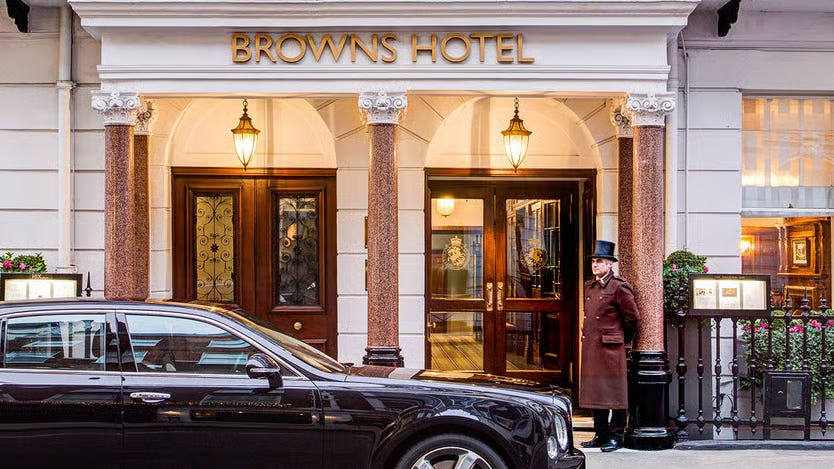
While sales of luxury goods like handbags and high heels are expected to fall 2-5% this year, luxury travel is booming, with global spending on luxury hospitality projected to rise from $239 billion in 2023 to over $390 billion by 2028 as wealthy consumers prioritize exclusive experiences over widely available designer items. However, luxury-travel firms risk repeating fashion brands’ mistakes by expanding too aggressively—luxury hotel rooms are expected to grow from 1.8 million to 2.2 million by 2030—and raising prices too steeply, potentially diluting exclusivity and alienating customers. The most successful approach may follow Hermès’ model: maintaining small scale, modest price increases, and personal touches like Brown’s Hotel’s doorman greeting guests by name, preserving the authentic exclusivity that defines true luxury in an era when material goods have become commonplace.
The Daily Spark
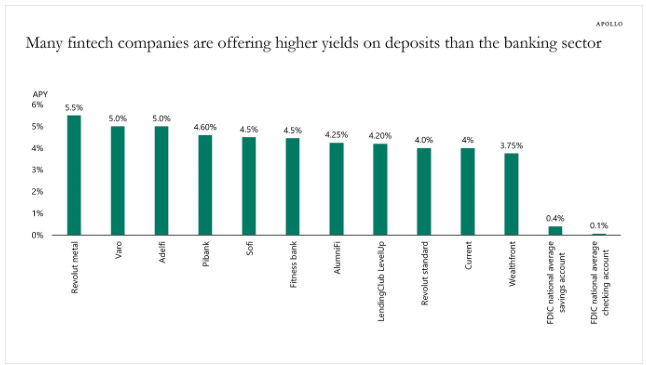
Yield levels on deposits in many fintech companies are dramatically higher than yield levels on deposits in the banking sector, see chart below. It is a fundamental imprudence in banking to finance long-horizon assets with short-term liabilities.
Quote of the Day
“If you look for perfection, you’ll never be content.”
― Leo Tolstoy, Anna Karenina