

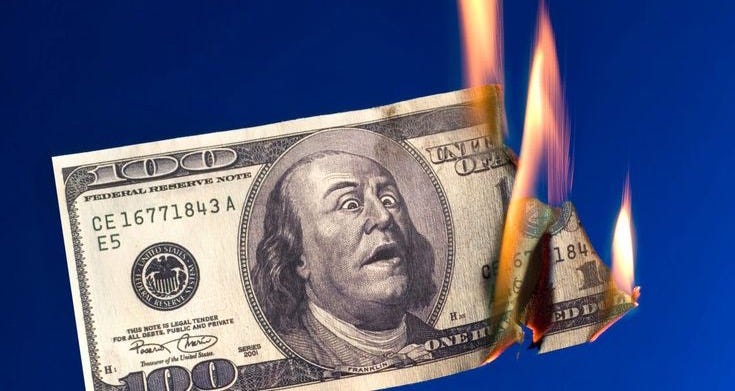
Consider the twenty-dollar bill in your wallet. Strip away the institutional backing, and you’re holding a piece of paper with no intrinsic value. Your bank balance is merely a database entry. Money, in the modern economy, is fundamentally an agreement, a shared belief that these representations hold purchasing power because governments say they do.
But agreements require trust. And right now, that trust is eroding.
This erosion has a name in financial circles. The debasement trade represents a fundamental shift in investor behavior, a migration away from fiat currencies like the U.S. dollar and toward hard assets that can’t be printed into oblivion. Understanding this trade matters because it’s reshaping everything from Treasury yields to the price of your next apartment lease.
The debasement trade emerges from a simple observation about developed economies pursuing fiscal policies that appear structurally unsustainable. High debt levels, particularly when paired with aggressive deficit spending, create an implicit tax on currency holders through inflation. The value of your savings gets quietly eroded not through explicit taxation, but through the steady expansion of the money supply.
The Trump administration’s fiscal expansion, embodied in legislation like the “Big Beautiful Bill,” exemplifies this dynamic. Massive deficit spending without corresponding revenue increases signals to markets that inflation, rather than fiscal discipline, will eventually bridge the gap. Bond markets have responded accordingly: long-term government yields are rising as investors demand higher risk premiums to compensate for inflation risk.
This isn’t uniquely American. Japan, despite maintaining one of the highest debt-to-GDP ratios in the developed world, has historically suppressed yields through aggressive central bank bond purchases. But even this carefully managed system is showing stress. Prime Minister Ishiba’s recent ¥113 billion fiscal stimulus package sent Japan’s 10-year bond yields up 1.8% and 30-year yields up 3.3%, a significant move in typically placid Japanese debt markets.
When government debt becomes this entrenched, investors face a binary choice: believe in the sustainability of current fiscal paths, or hedge against eventual currency depreciation. Increasingly, they’re choosing the latter.
Gold and silver have surged to record levels in 2024-2025, driven by this flight to real assets. Central banks in China and Russia have accelerated their gold purchases, effectively diversifying away from dollar reserves. Major institutional investors are following suit. The Ontario Teachers’ Pension Plan, managing over $200 billion in assets, has notably increased allocations to hard currency hedges this year.
Bitcoin, despite its reputation as “digital gold,” hasn’t benefited from this trend. Its price has declined, suggesting markets still view it as a risk asset rather than a true inflation hedge. The debasement trade favors tangible assets with centuries of precedent, not speculative technology.
Critics point to conflicting signals. The 10-year U.S. Treasury yield has actually trended downward in 2025 after a mid-year spike, suggesting robust demand for American debt. The dollar, after a weak first half, has stabilized as tariff concerns eased. Credit spreads remain tight, equities continue hitting all-time highs. These are hardly signs of systemic breakdown.
Perhaps the debasement trade is premature. After all, fiscal sustainability is a relative concept. If every major economy is pursuing similar policies, where else can capital go? The U.S. might still represent the “cleanest dirty shirt” in a laundry basket of overleveraged nations.
The debasement trade reflects deeper anxieties about the world we’re living in. Unsustainable government debt, geopolitical fragmentation, the erosion of the post-World War II economic order. These aren’t abstract concerns. They determine whether your salary keeps pace with inflation, whether government bonds remain viable retirement investments, whether the economic system delivers the stability previous generations enjoyed.
Yet the system keeps functioning. Institutional investors are hedging risk, but they’re not abandoning ship entirely. The Ontario Teachers’ Pension Plan increased gold exposure while maintaining their equity portfolio. Markets continue to price in growth alongside uncertainty. The world economy has proven remarkably resilient through COVID, supply chain disruptions, regional conflicts, and political dysfunction.
History offers a useful lens. The past was never as stable as nostalgia suggests. The present, while uncertain, retains structural strength beneath the volatility. The future will likely muddle through in ways no one can fully predict. The debasement trade represents rational risk management in uncertain times rather than prophecy of imminent collapse.
For our generation, this creates both challenge and opportunity. We’re entering an economy where the old assumptions no longer hold, where trust in institutions must be continually reassessed rather than assumed. The investors moving into gold are adapting to a world where currency stability can no longer be taken for granted. Whether you choose to follow their lead depends on your own risk tolerance and time horizon. But understanding why they’re making these moves gives you the tools to navigate an economy in transition, where the only certainty is that the rules will keep changing.