

Imagine it’s a crisp December afternoon on the Brown University campus in Providence, Rhode Island. Finals week is in full swing, and you’re one of dozens of students crammed into Room 166 of the Barus and Holley Building, the heart of the engineering and physics departments. The room buzzes with nervous energy—notebooks open, laptops glowing, whispers about problem sets and formulas. A teaching assistant leads a review session for Principles of Economics, that foundational course on incentives, markets, and human behavior. You’re scribbling notes, maybe stressing about the upcoming exam, when suddenly the door swings open.
A figure in dark clothing steps in, silent and purposeful. Before anyone can react, gunfire erupts—sharp cracks echoing off the walls. Screams fill the air as students dive under desks, hearts pounding. You drop to the floor, crawling toward cover, the acrid smell of gunpowder mixing with panic. Bullets whiz overhead; glass shatters. In those chaotic moments, two classmates, young lives full of promise, lie motionless. Nine others writhe in pain. The shooter flees as quickly as he appeared, leaving behind terror and blood.
This isn’t a hypothetical. On December 13, 2025, this nightmare unfolded at Brown, killing two students—Ella Cook and Mukhammad Aziz Umurzokov—and wounding nine during an economics review session. The campus locked down; finals canceled; a community shattered.
Mass shootings like this are statistically rare. According to the Mass Killing Database at Northeastern University, 2025 saw only 17 mass killings (incidents with four or more deaths), the lowest in two decades and down from 42 in 2023. The Gun Violence Archive, using a broader definition that includes incidents with four or more people shot regardless of fatalities, recorded 391 mass shootings by mid-December 2025, down from 474 at the same time in 2024 and 622 in 2023. As of December 15, 2025, there have been 13,929 total shooting deaths nationwide this year, representing a 14% decline from 2024 and a 30% drop from 2021 levels.
Yet, as this weekend grimly illustrated, they are not isolated. On December 14, two gunmen targeted a Hanukkah celebration at Sydney’s Bondi Beach, killing 15 and hospitalizing at least 42 in Australia’s deadliest mass shooting in nearly 30 years, declared a terrorist act motivated by antisemitism. Earlier in 2025, conservative activist Charlie Kirk was assassinated during a public event at Utah Valley University on September 10, shot in the neck by a gunman positioned 142 yards away on a rooftop. The previous year brought assassination attempts on former President Donald Trump and the targeted killing of UnitedHealthcare CEO Brian Thompson by Luigi Mangione.
Americans have long accepted that freedoms, like gun ownership and free speech, come with costs. But increasingly, society seems to resolve grievances through violence rather than discourse. What drives this shift? Why does division breed bullets?
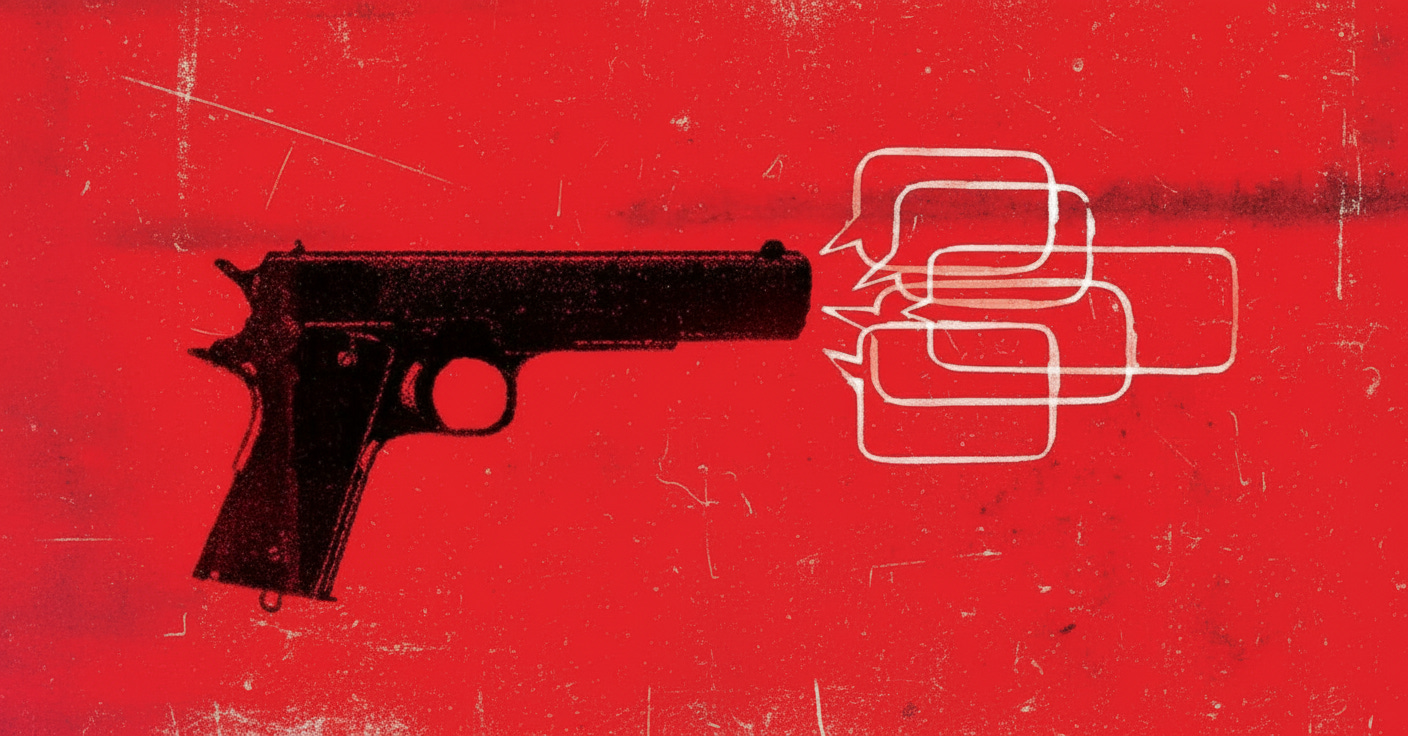
Psychology offers clues. Studies of mass shooters reveal common traits: aggression, narcissism, low self-esteem, depression, and fame-seeking. Research shows many exhibit antisocial or paranoid personality features, with aggression as a recurring thread. Yet individual pathology alone doesn’t explain the pattern; many perpetrators cling to intense partisan or ideological identities that justify their actions.
Social media amplifies this. Platforms create echo chambers, reinforcing extreme views and spreading misinformation. Research confirms that negative, high-arousal content—like anger and hate—spreads faster than positive or neutral messages, with algorithms prioritizing engagement and pushing users toward radical material. Many shooters display mental instability, consuming echo-chamber content that feeds paranoia and justifies violence.
Zooming out, this reflects deepening U.S. divisiveness. Affective polarization, emotional disdain for the opposing side, has skyrocketed. Research shows that from 1978 to 2018, the average American’s rating of their own political party versus the opposing party on a “feeling thermometer” (0-100 scale) widened from 27 points to a much larger gap, with the U.S. polarizing faster than comparable democracies including the U.K., Canada, Australia, Germany, and others.
Pew Research data reveals that 92% of Republicans now position themselves to the right of the median Democrat, while 94% of Democrats are to the left of the median Republican, a dramatic reduction in ideological overlap. The share of Americans with consistently conservative or consistently liberal views has doubled from 10% in 1994 to 21% today. By 2010, one-third of Democrats and half of Republicans reported they would be upset if their child married someone from the opposing party, up from just 4-5% in 1960.
A 2023 study found that since 2016, Democrats’ negative views of Republicans increased by an average of 18 percentage points across categories like “closed-minded,” “dishonest,” and “immoral,” with the “immoral” perception jumping 28 points. Republicans’ negative views increased by nearly 21 percentage points, with their perception of Democrats as “immoral” rising 25 points. An overwhelming 84% of Americans say political debate has become less respectful in recent years, and 79% describe U.S. politics using negative terms.
High-profile cases highlight these patterns. The Kirk assassination and Trump attempts were linked to partisan fury. Mangione’s killing of Thompson—perceived as a symbol of corporate greed—drew online celebration, with hashtags like #FreeLuigi garnering thousands of shares and polls showing younger Americans viewing him favorably amid healthcare frustrations.
Research shows that negative content thrives online because anger spreads rapidly, with algorithms boosting high-emotion material. This creates a feedback loop where extreme responses gain more attention than moderation.
The economic costs of gun violence are staggering. According to research by Everytown for Gun Safety and Harvard Medical School published in JAMA, gun violence costs America an estimated $557 billion annually—equivalent to 2.6% of the nation’s GDP. This figure is five times the entire Department of Education budget and more than twice what was spent to educate U.S. youth in FY 2022 ($235.74 billion).
This $557 billion breaks down into immediate costs (police response, ambulances, emergency medical treatment), subsequent costs (long-term physical and mental health care, lost earnings from disability or death, criminal justice expenses), and quality-of-life costs (estimated at $489.1 billion annually for pain, suffering, and lost well-being). Taxpayers alone pay $12.62 billion each year—$273,904 per firearm death and $25,150 per nonfatal injury.
The daily toll is crushing: taxpayers and families pay $7.79 million daily for medical care; $147.32 million in wages are lost daily due to injury or death; employers lose $1.47 million daily in productivity; and society loses $1.34 billion daily in quality-of-life costs. School shootings disrupt billions in educational investment, depress local property values, and strain public resources.
But these numbers, cold and abstract, pale beside the human devastation.
For those who survive, the world is never the same. The colors drain from everyday life: the once-vibrant autumn leaves on College Hill now seem muted, the laughter in a crowded café sounds hollow and distant. Simple acts—walking to class, sitting in a lecture hall, even hearing a door slam—trigger a surge of dread. Every stranger becomes a potential threat; every shadow hides the outline of a gunman stepping through the door. Joy feels fragile, trust eroded. Survivors carry an invisible weight: hypervigilance that exhausts the spirit, nightmares that steal sleep, a profound sense of vulnerability that no amount of time fully heals.
Yet there is a way forward, and it begins with each of us. We must recognize that division and alienation do not resolve our problems—they breed more violence. These acts play out on a small, intimate scale today, but history warns us that when deep differences are settled through hatred rather than dialogue, the result on a larger scale is war.
One of democracy’s greatest gifts is the ability to be heard, to disagree passionately, to advocate fiercely—without ever raising a hand, or a weapon. We honor the lost, heal the wounded, and protect the future by reclaiming that gift: choosing words over bullets, understanding over outrage, and connection over isolation. Only then can we restore the color, the light, and the trust that violence has stolen.