

Picture this: You’re almost 30. You’ve just finished your MBA at Harvard after years in corporate America—first as a derivatives trader on Wall Street, then at Starbucks, then a sustainability startup. Behind you? A decade of climbing ladders that all led nowhere. A half-million dollars in debt from student loans and credit cards. Acute dermatitis covering your skin from testing too many products during an overzealous internship. And the toxic corporate culture where you were called a “dumb fuck” and had to worry about colleagues touching you.
Ahead of you? Two paths.
Path one: Return to the safety of corporate America. Keep climbing. Keep pretending you belong in spaces that don’t want you. The expected choice.
Path two: Risk everything on a wild idea that hit you during a trip to Kyoto, Japan—where you discovered ancient geisha skincare rituals that healed not just your skin, but your spirit.
Here’s my question for you: When you’re drowning in debt with no safety net, would you still bet on yourself?
This isn’t hypothetical. This was Vicky Tsai’s reality in 2009. And what she did next—selling her engagement ring, moving back in with her mom, working four jobs while building a beauty company from her garage—would eventually create an empire worth half a billion dollars. But the path there? It’s messier, more brutal, and frankly more interesting than any business case study you’ll read this semester.
Because here’s what Vicky would later reveal: Tatcha wasn’t just about disrupting an industry. As she put it, she created Tatcha so that she would have a place in the world where she felt like she could exist and be with people she admired. A second home and family. Sometimes the best businesses aren’t born from market analysis, they’re born from the desperate need to create a world you actually want to live in.

Let’s be real about what Vicky was walking into.
The skincare industry in 2009 wasn’t some wide-open frontier. It was a battlefield dominated by giants. Estée Lauder had been around since 1946. Lancôme since 1935. These weren’t just brands, they were institutions with bottomless marketing budgets, armies of chemists, and distribution networks that took decades to build.
And if Vicky thought “Japanese beauty” would be her differentiator? Shiseido had been perfecting that story since 1872.
So when Vicky started pitching Tatcha to potential investors and retailers, armed with nothing but her HBS network and a vision, she got exactly what you’d expect: “Asian beauty is not aspirational in the U.S.” “Too niche.” “Too exotic.” Rejection after rejection.
If you were sitting across from her in 2009, calculator in hand, would you have written that check?
Probably not.
Here’s where Vicky made her first genius move.
She didn’t launch with a face cream. She didn’t try to out-moisturize the giants. Instead, she started with something completely different: blotting papers.
Specifically, Aburatorigami—gold-flecked Japanese blotting papers inspired by a centuries-old tradition. Gold artisans in Japan used sheets of abaca leaf paper to protect precious metal while hammering it into thin leafing. Resourceful geisha discovered these sheets could also absorb oil from their skin without disturbing their elaborate makeup.
(For anyone unfamiliar with skincare: blotting papers are thin sheets that absorb excess oil from your face throughout the day. Think of them like those oil-absorbing sheets you’d use on a frying pan, but for your face.)
Vicky sold her engagement ring, moved back in with her parents, and launched Tatcha in 2009. It was a tactical decision—blotting papers required less capital, less R&D, and could test whether her vision had legs.
But here’s what made them brilliant: Vicky wasn’t selling oil control. She was selling “The Ritual of the Geisha”1—a centuries-old beauty practice, now accessible in a gold-adorned package that whispered luxury and exclusivity.
The papers became instant cult favorites. Makeup artists started using them. Celebrities requested them. And Vicky had her proof of concept.
For the first three years, Tatcha sold only blotting papers.
This wasn’t impatience or poor planning, it was intentional. Vicky was pregnant when she launched the brand, and acutely aware that if she wanted to create authentic Japanese skincare formulas, she couldn’t cut corners. She hired her own scientists, grew her own plants, made her own extracts from scratch. “Like a couture dress,” she described it.
In 2012, she finally launched Tatcha’s full skincare collection—cleansers, moisturizers, treatments, all built on that same promise of Japanese ritual and self-care.
She wasn’t positioning Tatcha as a solution to your skin “problems.” Every other brand was already doing that, telling customers there was something wrong with them that needed fixing. Vicky sold something else entirely: permission. Permission to slow down. Permission to take five minutes in your chaotic, burnout-inducing day to perform a ritual. Permission to practice self-care without guilt.
She wasn’t selling you skincare. She was selling you an escape from the grind that she herself had fled.
The pricing? Premium. Not just competitive with Estée Lauder or Shiseido, but more expensive. And it worked. Her burnt-out, overworked network didn’t blink at the price. They got it. They craved what she was selling: a moment of peace wrapped in Japanese ritual and luxury packaging.
Tatcha started growing. Fast.
Then came the call that changes every founder’s trajectory.
Sephora—the Sephora—wanted to stock Tatcha nationwide. This was before Instagram beauty took over, before TikTok made products go viral overnight. If you wanted to scale a beauty brand in the early 2010s, you needed shelf space. And Sephora offered the golden ticket: instant distribution, millions of customers, legitimacy.
Pop quiz: If you’re Vicky, do you take the deal?
Of course you do. Every business textbook tells you to scale. Every advisor tells you distribution is king. You’d be insane to say no.
Vicky said yes.
And it nearly destroyed Tatcha.
Here’s what Vicky didn’t anticipate: the moment Tatcha hit Sephora shelves, it lost its soul.
Remember what made Tatcha special? The exclusivity. The Ritual of the Geisha. The feeling that you were part of something intimate, something rare. The brand promised slow in a world obsessed with fast.
Now picture that same product sitting on a shelf between fifty other moisturizers, under fluorescent lights, while shoppers speed-walk past comparing prices on their phones. Where’s the ritual now? Where’s the permission to slow down?
Gone. Vaporized.
The sales tanked. Hard. Tatcha, the brand that had been growing month over month, was suddenly hemorrhaging money. The dream that Vicky had bet everything on—that she’d sold her engagement ring for, that she’d spent three years carefully building—was dying. She was staring down bankruptcy.

Most founders would’ve quit here. Chased the sunk cost fallacy back to a safe job. Written it off as a learning experience.
Vicky didn’t.
Vicky pulled Tatcha out of Sephora and went back to zero. But this time, she understood something crucial: distribution matters, but alignment matters more.
She started rebuilding Tatcha’s presence, but strategically this time. Luxury spas. Five-star hotels. Boutique retailers who understood the brand’s ethos. Places where the clientele wasn’t just price-shopping, but experience-shopping. Places where dropping $100+ on skincare wasn’t a second thought—it was an expected indulgence.
More importantly, these venues aligned with Tatcha’s brand promise. A spa isn’t about rushing. A luxury hotel isn’t about convenience. They’re about slowing down, about ritual, about taking care of yourself.
This is the same playbook lululemon ran with $128 yoga pants (they’re not selling activewear; they’re selling a wellness lifestyle). It’s what Jellycat does with $50 stuffed animals (they’re not selling toys; they’re selling permission for adults to embrace comfort and nostalgia).
Tatcha wasn’t selling skincare. It was selling a feeling. And finally, Vicky had found the right stage to perform on.
The brand grew. Slowly at first, then exponentially. Eventually, Vicky did return to Sephora, but this time on her own terms, with the brand identity firmly established and a loyal customer base that understood what Tatcha represented.
The famous Dewy Skin Cream that would later become one of Tatcha’s hero products? That didn’t launch until 2019, a full decade after Vicky started the company. By then, Tatcha was selling once every 30 seconds and had become one of Sephora’s top-selling brands.
That same year, Unilever acquired Tatcha in a deal reportedly worth $500 million.
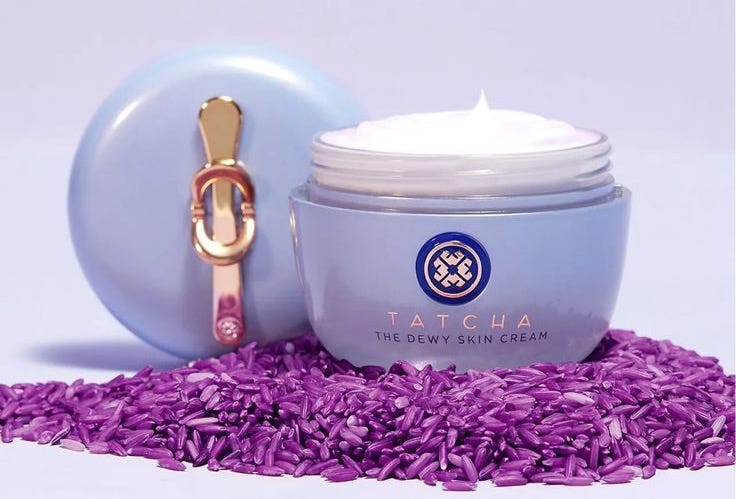
I first discovered Tatcha while searching for skincare products after my own trip to Japan. I’d fallen in love with Shiseido products and wanted to explore more from that region. That’s when I found Tatcha’s Dewy Skin Cream, now retailing at $97 in Canada.
Let me put that in perspective: that’s 30-50% more expensive than comparable products from Shiseido, Estée Lauder, or Kiehl’s. My immediate reaction? Sticker shock. Who pays that much for moisturizer?
But here’s what I’ve learned from Vicky’s story: price isn’t just about the product. It’s about the promise.
If that $97 Tatcha cream delivers a sense of peace, ritual, and self-care that a $62 Estée Lauder cream can’t match? If it transforms five minutes of your morning into a moment of permission and freedom? Then that extra $35 isn’t a markup—it’s an investment in yourself.
And that’s the lesson for our generation.
We’re the burnout generation. We inherited a world of optimization, productivity hacks, and hustle culture. We’re told to move fast and break things. But Vicky’s story is a reminder that sometimes the most radical thing you can do is slow down—and help others do the same.
Look around. What problems do you see that aren’t really about the product, but about the feeling? What pain points exist that no one’s addressing because they’re too busy optimizing the wrong thing?
Maybe it’s an app. Maybe it’s a service. Maybe it’s a physical product like Tatcha. But the opportunity isn’t in doing what everyone else does, slightly better. It’s in reframing the entire problem.
Vicky didn’t win by making better skincare than Estée Lauder. She won by understanding that her customers didn’t need better skincare—they needed permission to care for themselves. And she was willing to start small (blotting papers!), fail publicly (the Sephora disaster), and rebuild strategically until she got it right.
What problem can you reframe? What permission can you sell?
The beauty of Vicky’s journey is that she didn’t have some revolutionary product or technology. She had blotting papers and a story. She had resilience when the “obvious” move (Sephora!) nearly killed her dream. She had the courage to bet on alignment over distribution, on slow growth over quick scale.
As for me, I might actually buy that $97 Tatcha Dewy Skin Cream one day.
Not because my skin desperately needs it (though Toronto winters are brutal). Not because I’m a skincare obsessive (I’m decidedly not).
I’ll buy it because it’s more than a cream. It’s a reminder that you can burn it all down and rebuild something meaningful. It’s proof that the “safe” path isn’t always the right path. It’s a small, luxurious act of rebellion against a world that tells us to move faster, optimize harder, hustle more.
And maybe, just maybe, it’ll give me the courage to build something of my own.
Note: This is one of those stories that reminded me why I love writing about business. There’s something special about founders who bet everything on a vision that seems impossible. Next up? I’m diving into the Estée Lauder story—another tale of grit and audacity that I can’t wait to share.
If you want to experience Tatcha for yourself, check out the link below.
Tsai, Vicky. “A Geisha’s Skincare Routine.” Tatcha. Accessed November 26, 2025. https://www.tatcha.com/blog/geisha-skincare-routine.html.