

Has anyone ever asked you what you plan to do after college? It’s the question that haunts every student interaction with relatives, career fairs, and late-night anxiety spirals. But here’s what makes it different for Gen Z: we’re being asked this question in an economy that seems to have no good answers.
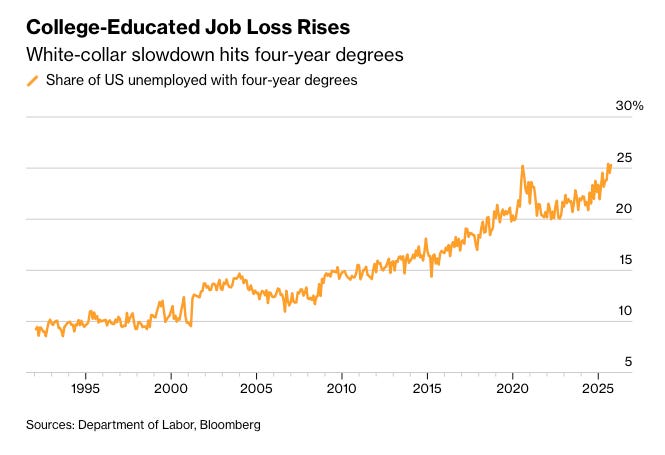
The latest job data paints a sobering picture. Americans with a college degree now account for 25% of unemployment, and the unemployment rate for those aged 20-24 has climbed to 9.4%—up 2.2 percentage points from just a year ago, according to Bloomberg. For a generation that was told education was the golden ticket, this feels less like the beginning of a Disney movie when the hero loses everything.
What’s really going on in the labor market, and more importantly, what does this mean for your future?

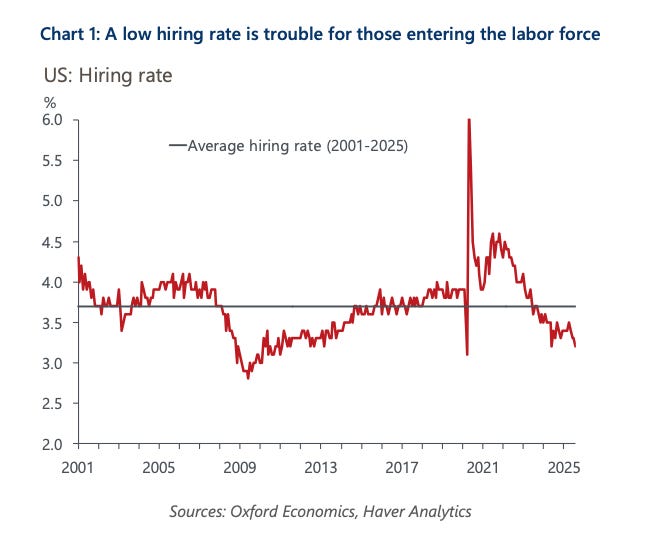
Since the end of the COVID-19 pandemic in 2022, the economy has entered what economists call a “low hire, low fire” environment. Companies went on hiring sprees during the pandemic and are now sitting tight, neither adding nor cutting employees significantly. Outside of higher-risk sectors like tech, this means those who have jobs enjoy relative security—but for older Gen Z (born between 1997 and 2003), it means the door to the job market feels permanently locked.
The hiring rate has been trending downward since 2022 and now sits at 3.2%, notably below historical averages. This isn’t just a number on a chart. It has real, cascading consequences.1
Weakening job prospects and soaring housing costs are forcing more young adults to live with their parents. This living arrangement reduces spending on transportation, leisure, and food by as much as $1.2 billion collectively, shrinking Gen Z’s economic footprint. Instead, the economy increasingly relies on older, affluent spenders.
Then there’s the elephant in the room: generative AI. The technology excels at replacing entry-level office work, those jobs where you spend all day filling Excel spreadsheets or building PowerPoint decks. Companies aren’t shy about celebrating how AI helps them “operate more efficiently with leaner teams.” Translation: fewer jobs for recent grads.
Add political uncertainty around trade and immigration, and you have a labor market that feels uniquely cruel to new graduates.
If the story ended with “tough economy, wait it out,” that would be one thing. But there’s a deeper problem brewing: the over-professionalization of undergraduate education.
Will Bunch captured this shift perfectly, asking:
“Have the scales of academia—weighed down by soaring tuition and the expensive real world that awaits Gen Z college grads—tipped too far toward pre-professionalism, a term for careerism on steroids? And are students too focused on getting into the right campus clubs and nabbing the perfect internships to reap the advantages of a diverse, liberal-arts education?”2
Consider Isabella Glassman’s viral New York Times op-ed, “Careerism Is Ruining College.” She wrote: “I’d wake up at 3:30 a.m. from the recurring nightmare that I didn’t land an internship my junior year summer. I heard people, maybe friends, endlessly discussing the ‘only way’ to be successful. I consoled a sobbing roommate after she failed to land the job her parents expected her to get.”3
This anxiety has pushed students toward career-focused majors like business and computer science, while enrollment in sociology, English literature, and other humanities has plummeted to record lows. We’re told to specialize early, commit to a path, and never deviate. The unspoken message: pick the right major at 18, or spend your life explaining to relatives why you’re not using your degree (while making student loan payments on it until you’re 40).
But the irony is that in an age of AI disruption, the job market increasingly demands generalists, people who can think across disciplines, adapt quickly, and solve problems creatively. Yet we’ve created a system that demands early specialization while the economy is beginning to favour broad adaptability coupled with domain expertise. It’s a structural mismatch.
![OC] U.S. Computer Science Bachelor's Degrees Awarded by Year : r/dataisbeautiful](https://substackcdn.com/image/fetch/$s_!8orS!,f_auto,q_auto:good,fl_progressive:steep/https%3A%2F%2Fsubstack-post-media.s3.amazonaws.com%2Fpublic%2Fimages%2Fa18e2d70-c27f-4d4e-a510-2a5e238678fc_640x544.png "OC] U.S. Computer Science Bachelor's Degrees Awarded by Year : r/dataisbeautiful")
This is the darkest part of our story. The hero has trained for one specific quest, only to discover the quest has changed entirely.
But here’s where every Disney movie takes its turn. Think about Frozen: Elsa spent years hiding her powers, convinced they were a curse that would hurt everyone she loved. She tried to be the perfect, controlled princess. But the moment she stopped trying to fit the mold and embraced what made her different? That’s when her “weakness” became her greatest strength. The powers she feared were exactly what her kingdom needed.
Your superpower isn’t your major. It’s your ability to learn, adapt, and connect dots others can’t see.
So what does this mean practically?
Embrace intellectual curiosity across domains. That philosophy class might teach you how to construct arguments in negotiations. That art history course might help you understand visual communication in product design. As biomedical entrepreneur Sangeeta Bhatia, who launched eight biotech companies, put it: creating something new requires inspiration, and students need exposure to as much outside their field as in it.
Leverage your “weird” skillset. Coded a bit, wrote for the paper, volunteered teaching kids? That’s someone who can build educational technology and explain it to non-technical stakeholders. Your unique combination is your competitive advantage—AI can’t replicate your specific journey.
Stay relentlessly adaptable. Your first job won’t be your last. The industry you start in won’t be where you retire. Gen Z’s greatest advantage? We’re digital natives who’ve grown up in constant change. This adaptability is our superpower.
Every Disney hero realizes they’ve had the power all along—they just needed to see themselves differently. The same is true for you.
Yes, the economy is tough. Yes, AI is disrupting entry-level work. These are real challenges. In a world where AI can write code and analyze data, your value comes from being distinctly human: your curiosity, your ability to learn, and your capacity to connect ideas from different domains.
So keep learning. Keep connecting. Keep combining your interests in ways that don’t make sense to anyone else.
And if Disney has taught us anything, it’s that the most magical endings come when the hero discovers they were capable of so much more than they ever imagined.
Your adventure is just beginning.
P.S. I encourage you to explore the sources provided below.
To read more: Zwemmer, Grace. “Research Briefing | US: The kids aren’t alright – Economic health of Gen Z.” https://cdn.roxhillmedia.com/production/email/attachment/1770001_1780000/3b5ad7d0f0dcd3845ad3753d419cfcce9f9607c5.pdf.
Bunch, Will. “Is Careerism Ruining College? Preprofessionalism vs. Liberal Arts and Gen Z.” Brown Alumni Magazine, April 10, 2025. https://www.brownalumnimagazine.com/articles/2025-04-10/is-careerism-ruining-college-preprofessionalism-vs-liberal-arts-gen-z.
Glassman, Isabella. “Careerism Is Ruining College.” The New York Times, September 24, 2024. https://www.nytimes.com/2024/09/24/opinion/college-linkedin-finance-consulting.html.
"Keep combining your interests in ways that don’t make sense to anyone else." slay